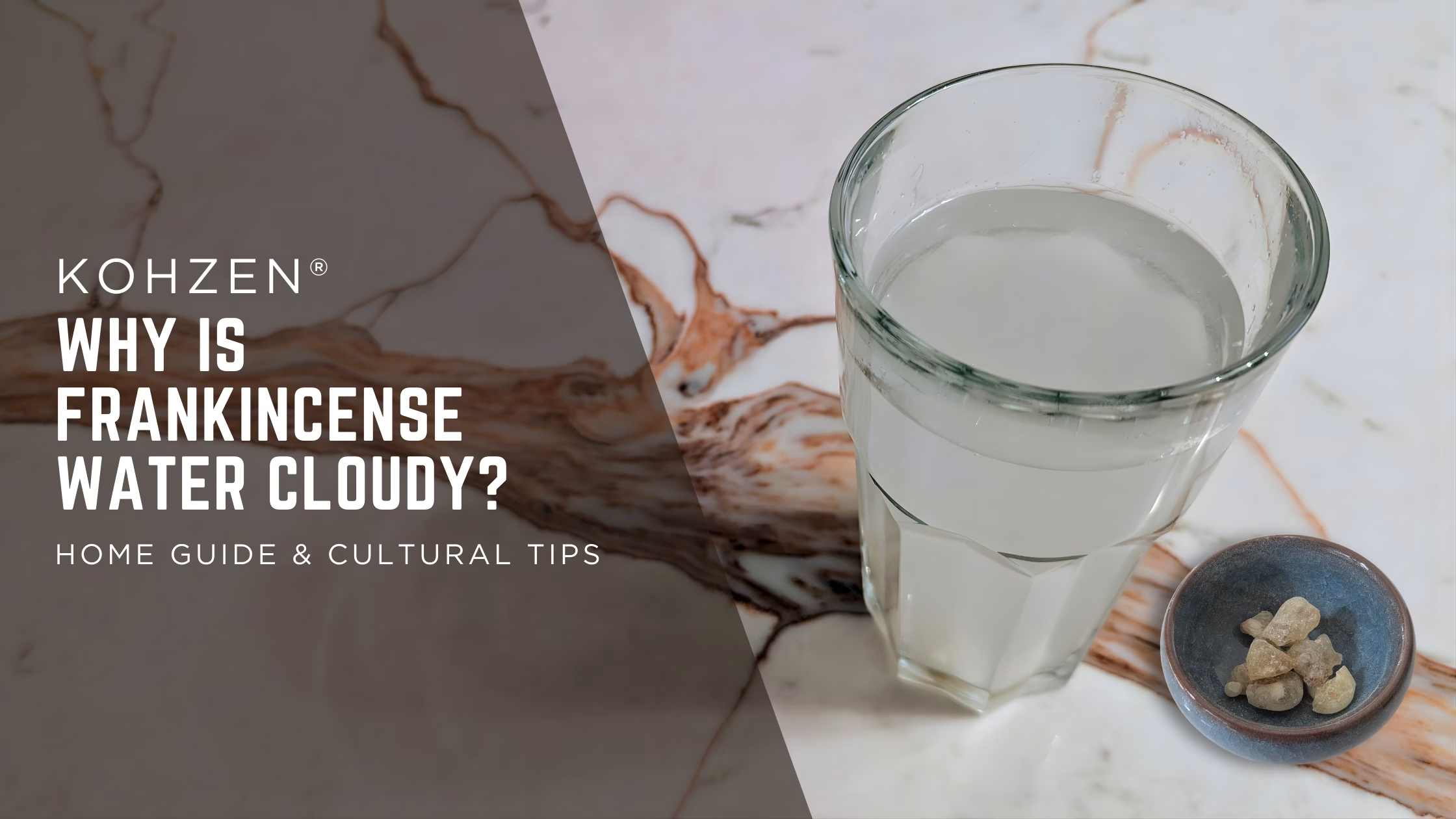
Frankincense water is simply a homemade herbal infusion made by steeping frankincense resin in water herbaldimensions.com. Traditionally popular in West Asia (especially Oman, Yemen, and Arabia) and parts of South Asia and Africa, this practice turns centuries old knowledge into a modern ritual. As one source explains:
“Frankincense water is an infusion of Frankincense resin in water. It is a traditional Middle Eastern preparation…” herbaldimensions.com.
Why is frankincense water cloudy? In practice, you take pure frankincense “tears” – the natural sap resin of the Boswellia tree – and let them sit in warm (or sometimes cool) water. Over hours or even overnight, the water absorbs some of the resin’s aromatic oils and water-soluble compounds, producing a lightly fragrant drink.
This method has humble roots: for generations, people from Bedouins to yogis have prepared simple frankincense water as a soothing beverage, a spiritual offering, or a cleansing rinse for the skin. While it’s not a commercial product, it connects modern wellness with a cultural tradition of using incense resins for refreshment. (For more on these traditions, see our post “7 Traditional Uses of Frankincense Water”.)
Cultural & Historical Significance
Frankincense (often called lubān al-dhakar in Arabic) is more than an ingredient; it’s a heritage. The UNESCO World Heritage site “Land of Frankincense” in Oman commemorates how this resin fueled ancient trade routeswhc.unesco.org. For centuries the incense trade was one of the world’s most important commoditieswhc.unesco.org, and frankincense figured in religious offerings, royal ceremonies, and daily rituals. Today in Dhofar (Oman) and beyond, frankincense is still valued as a sacred gift – and drinking frankincense water can be seen as part of that living tradition.
Even outside the Middle East, many Ayurvedic and traditional medicine systems recognise boswellia (frankincense) resin. Traditionally it was used in teas or decoctions (often post-fasting or after a meal) for general well-being. In some cultures, for example, elders might sip a bit of frankincense water as a digestive aid or to soothe tension at the end of the day. Though we won’t make medical claims here, it’s worth noting that these folk uses reflect a respect for frankincense’s aromatic and potential soothing properties. The key takeaway: frankincense water is embedded in tradition and ritual, valued for its sensory experience as much as anything else.
Curious about how to use frankincense resin in different ways? Explore our Ultimate Guide to Frankincense to learn about its rich history, spiritual uses, and practical rituals.
Why is Frankincense Water Cloudy?
The signature cloudiness is a very common outcome of making frankincense water, and it has straightforward causes:
Natural Resin Composition: Frankincense is an oleo-gum-resin, meaning it contains aromatic oils, hard resins, and sticky gummy polysaccharides. When you soak the resin in water, the water-soluble gums (polysaccharides) dissolve and swell. These form tiny suspended particles (a mucilaginous suspension), which scatter light and make the liquid look milky ayublab.comresearchgate.net. In fact, analysis of Boswellia sacra (Omani frankincense) shows about 27–35% of its weight is water-soluble gum. Those polysaccharides make the frankincense more cloudy, as one source notesayublab.com.
Temperature: Hot water helps release more of the resin’s gums and oils, which can accelerate cloudiness. If you pour boiling water over the resin, you’ll often see a rapid milky cloud form as the resin “dissolves.” Cooler water steeped overnight will turn cloudy more slowly but will still usually end up milky as the gums diffuse. Either way, some cloudiness is normal in a frankincense infusion.
Resin Quality and Type: Not all frankincense resins behave the same. For example, Boswellia frereana (sometimes called Maydi incense) is unique in that it lacks significant water-soluble gumresearchgate.net. An infusion with frereana resin may stay surprisingly clear, whereas other types (like B. sacra, B. carterii, B. serrata, or B. papyrifera) contain more gums and cloud up more. In other words, the specific species and even the grade of resin will influence cloudiness. Traditional sources often note that lighter-colored resins (like “Royal” or “Green” Hojari) are preferred for drinking because they yield a cleaner infusionherbaldimensions.com.
Water Minerals: Hard water or very mineral-rich water can introduce its own cloudiness (from calcium or other particles). If your tap water is very hard, you might see a white film or sediment from the minerals alone. Using filtered or distilled water can help clarify whether the murkiness is from the frankincense itself.
Other Particulates: Sometimes tiny fragments of resin (fine powder or grit) remain suspended. As you pour in water or stir, some resin bits may float around before settling. Over time they will sink or can be strained out. Shaking the container after adding water is a common step (as in one guide) and indeed “you should see your water go cloudy as the frankincense resin dissolves into the water”herbaldimensions.com.
In summary, the cloudiness usually comes from the gum components of the resin slowly releasing into the waterayublab.comresearchgate.net. It’s a natural, even expected phenomenon – not a fault.
Myths and Misconceptions: Is Cloudy Frankincense Water Bad?
It’s natural to worry that a cloudy drink might be spoiled or unsafe. Rest assured, in the case of frankincense water, milky cloudiness is not a bad sign (assuming the resin was clean to start with). It’s simply the resin’s benign plant gum at work. For example, chemistry experts explain that frankincense gums dissolve and create an “immiscible suspension (mucilage)” ayublab.com. This suspension is just like a herbal slurry – similar to how mint or ginger infusions might have tiny floaters.
Some people also confuse frankincense infusion with “oil in water” emulsions. However, frankincense oil itself is not very water-soluble; it tends to separate as a film. The cloudy part is primarily the polysaccharides and small resin particles. In fact, if you let frankincense water sit, you may eventually see a clearer layer and some sediment at the bottom – again, nothing harmful.
As long as you use clean glassware and fresh resin (without contamination), a milky frankincense infusion is as normal as tea turning a deep color. Many practitioners embrace the cloudiness as a sign that they’ve extracted the full essence of the resin. You can also use a fine cloth or coffee filter to strain the liquid – though you will also strain out some gum in the process, which many consider part of the experience and flavour.
Beginner-Friendly Tips for Making Frankincense Water
If you’re new to this infusion, a simple step-by-step approach can help:
Choose a Clean Container: Glass or ceramic is ideal. These won’t react with the frankincense oils. A clear glass jar lets you watch the infusion turn color or cloudyherbaldimensions.com. Make sure it’s well rinsed so no leftover soap or residue clings.
Use Whole “Tears”: Select high-quality, whole lumps of frankincense resin (see below). Start with about ½ to 1 teaspoon of resin per cup (200–300 ml) of water. You can break the resin into smaller pieces to fit, but whole pieces are easier to strain out later.
Pour Hot (or Warm) Water: Many people use boiled water that’s been allowed to cool slightly (to avoid scorching the resin). Pour over the resin in the jar and swirl gentlyherbaldimensions.com. A quick shake or stir helps wet all the resin. You’ll immediately see the water begin to cloud as the resin “dissolves” (really, disperses its gums)herbaldimensions.com.
Cover and Steep: Let the mixture infuse. You can steep for 2–4 hours on the countertop, or even overnight in the fridge. A gentle cover (like a lid or cloth) keeps dust out but allows a little air – but don’t seal an air-tight lid on hot liquid. The longer it sits, the more compounds release and the cloudier it may become. Many people find 8–12 hours (overnight) is convenient and yields a full-flavored brew.
Strain and Store: After steeping, strain the liquid into another container (glass pitcher or jar). You’ll likely see some sediment or soft white bits left behind. That’s normal – you can discard or even chew the leftover resin pieces to enjoy every bit (yes, people chew frankincense!). The strained water can be kept in a clean bottle. Store it in the fridge to preserve freshness. It will keep at least 2–3 days chilled; some say up to a week, but it’s best when fresh. Always give it a smell test: if it smells off or vinegary, discard it.
How to Drink: Enjoy your frankincense water cool or at room temperature. It has a light, zesty scent (similar to its resin’s citrusy aroma) and a slightly resinous taste. Some people sweeten it lightly with honey or a splash of fruit juice to balance the earthiness. Others add a slice of lemon or ginger to complement the flavor (though those ingredients will add their own cloudiness and taste). Remember this is a sensory experience – inhale the fragrance as you sip, and drink slowly.
Ongoing Use: Frankincense resin can be reused for multiple batches. After straining, add fresh hot water to the same resin again. It will still infuse but usually weaker each time. Continue until the water no longer turns milky or loses aroma.
Storage and Safety
Refrigeration: Keep the infused water refrigerated if not drinking immediately. This prevents any chance of unwanted bacteria growth. The cool temperature may slightly reduce cloudiness (polysaccharides can gel when cold) but that’s reversible when warmed back to room temp.
Cleaning: Always use a clean, dry spoon or ladle to scoop resin out, and wash your hands before handling. Treat the resin respectfully.
No Plastics: Acidic or oily resin components can leach plastics. Use glass or stainless vessels for storage.
Sunlight: Store in a dark place or amber bottle; sunlight can degrade fragrance and cause unwanted algal growth.
Warning: While frankincense is generally safe for most adults, avoid this drink if you have specific allergies or medical conditions without checking with a knowledgeable practitioner. (We won’t make health claims here – just enjoy it as a special aromatic drink.)
Want to go deeper into the cultural traditions behind frankincense water? Discover historical and everyday uses in our post 7 Traditional Uses of Frankincense Water.
Choosing Quality Frankincense Resin
The experience starts with the raw resin. For a clear (and clean-tasting) infusion, quality matters:
Species/Origin: The finest frankincense for drinking typically comes from Boswellia sacra (Oman, Yemen) or B. carteri (Somaliland). These are often labeled “Hojari” (especially the pale-green or white grades from Oman) or “Sookia”. Somali B. frereana (“Maydi”) is rare and pricier, but yields a very clear infusion because it has almost no water-soluble gumsresearchgate.net. Less expensive resins include B. serrata (India) and B. papyrifera (Ethiopia); these are still lovely but may be darker and cloudier.
Color and Appearance: Look for light-colored, translucent tears. High-grade Hojari is white, pale yellow or olive-green. Avoid resins that look very dark brown or have a burnt smell – those can be from over-heating or mixing with inferior frankincense (or other resins). Also avoid very dusty or powdery offerings; the high-quality tears are solid, glassy, and uniform. When broken open, a good piece often has a crystalline sheen inside.
Scent Test: True frankincense has a fresh, sweet-citrus aroma with piney, woodsy notes. Even before it’s in water, sniff a small piece. It should smell clean and uplifting. If it smells musty, moldy, or strongly perfumey (like artificial), that suggests impurities or additives.
Additive-Free: Always use 100% pure resin. Sadly, some cheaper products are “frankincense blends” or fillers. Genuine resin should dissolve only when powdered, not crumble into foreign particles. Buying from reputable incense dealers or herb shops (especially those transparent about origin) helps. Some sellers offer USDA Organic Boswellia or COP (certified Oman product) labels; these can give extra confidence.
What to Avoid: Do not use “ground frankincense” powders or resin stuck in oil (that’s for perfumes). Also skip any resin soaked in synthetic fragrance – the goal is a pure botanical infusion.
Selecting good resin not only improves taste, but also reduces unwelcome cloudiness from dirt or extraneous plant bits. As one source notes, “lighter resin is more pleasant” for consumptionherbaldimensions.com. Think of it as choosing the finest herb for tea – it matters!
Respectful Preparation Practices
In many frankincense-using cultures, preparing incense or water is a mindful act. While we won’t prescribe religious rituals, here are some respectful practices drawn from tradition:
Cleanliness: Start with clean hands, clean tools, and a clear mind. Frankincense is often called a “gift of the gods,” so handle it with care. Use dedicated tea/coffee utensils if possible.
Mindful Setting: Brew your infusion in a peaceful environment. Some people play soft music or say a few gratitude words as it steeps, turning it into a mini-ceremony. This aligns with the mindful aspect of enjoying a natural drink.
Proper Vessel: Traditionally, people might use a copper or brass vessel for boiling water (like making tea) because copper is said to bring out the herbs’ flavors. If you do heat it gently, a simple glass pot or ceramic is fine.
Offering: In Middle Eastern hospitality, serving frankincense tea/water to guests (sitting in a majlis or living room) is a gesture of welcome. You can follow that custom: pour small amounts into tiny glasses, and share it with friends or family as a special treat.
End with Gratitude: After brewing, some traditions invite you to inhale the steam or smoke a tiny pinch of leftover resin for an aromatic finish. Keep in mind no excess heat is needed – simply letting the spent resin warm on a hot plate to release final scent is enough. Always carry on the sense of respect for the plant source.
The key is intention: treat frankincense water not just as a drink, but as an experience that connects you to centuries of human tradition. Take a moment to appreciate the aroma and the ritual, even if it’s just you alone.
Frankincense Water Cloudy Takeaways
Cloudy frankincense water is usually just a sign that you’re extracting the good, sticky part of the resin – the very essence that centuries-old traditions have prized ayublab.com. Instead of seeing milky turbidity as a flaw, many call it the frankincense cloud and drink around it or sip despite it. With proper preparation and quality resin, you’ll find your frankincense infusion to be a fragrant, meditative beverage rather than a cause for alarm.
Q: Why does my frankincense water become cloudy or milky?
A: The cloudiness comes from natural components in frankincense resin. Frankincense contains sticky gum (polysaccharides) that dissolve into the water. These water-soluble gums form a fine suspension, making the liquid look milky. The aromatic oils from frankincense are mostly not water-soluble, so the visible cloud is mostly the gum and fine resin particles, not the essential oils. It’s normal – many users actually expect this cloud.
Q: Is cloudy frankincense water safe to drink?
A: Yes. Cloudiness in frankincense water is not harmful. It’s simply the resin’s natural gum. As long as you started with pure, clean resin and clean water, there’s nothing toxic in the cloudiness. People have used frankincense water for generations. To stay safe, use filtered water, clean jars, and refrigerate the brew. If unsure, you can strain the liquid through a cloth to remove particulates. The filtered water will still contain dissolved extracts and remains safe to drink.
Q: How long should frankincense resin soak for making water?
A: For a good infusion, soak frankincense resin in warm water for at least a few hours. Many people steep it overnight (8–12 hours) to maximise extraction of aroma and gums. Even 2–4 hours will give some flavor, but the longer soak (or repeated infusions) pulls out more scent. After straining the first brew, you can add fresh hot water to the same resin and steep again until the cloudiness diminishes.
Q: Can I filter or clarify frankincense water to remove cloudiness?
A: Yes – if the cloudiness bothers you, pour the cooled infusion through a very fine cloth or coffee filter. This removes the suspended polysaccharides and fine resin pieces. The filtered water will be more clear but will also lose some of the natural thickness and texture. Some enthusiasts prefer leaving the cloud for the “full” experience, but it’s a personal choice. Storing the strained water in the fridge also causes some gums to gel and settle, naturally clearing the liquid a bit.
Q: How do I store frankincense water and resin?
A: Store finished frankincense water in a sealed glass jar in the fridge. It will keep a few days safely, though it’s best enjoyed fresh. The remaining resin (after straining) can be left in the jar and re-used for another batch: just add more hot water to the old resin and steep again. Discard the resin once it no longer clouds the water or loses scent. Always label the jar with the date, and give it a sniff before drinking each day to ensure it still smells fresh.
If you’re looking for Real Frankincense Incense Sticks that actually smell like frankincense, the sacred, resinous clarity you recognise from churches, mosques and temples, this is your guide. I’m JP Kozah, founder of Kohzen. I source these Real Frankincense Incense Sticks directly from Oman. They are made in Oman using genuine Hojari Boswellia sacra resin from Dhofar, the UNESCO-listed Land of Frankincense. Hojari is widely considered the gold standard: bright, clean, unmistakably fragrant.
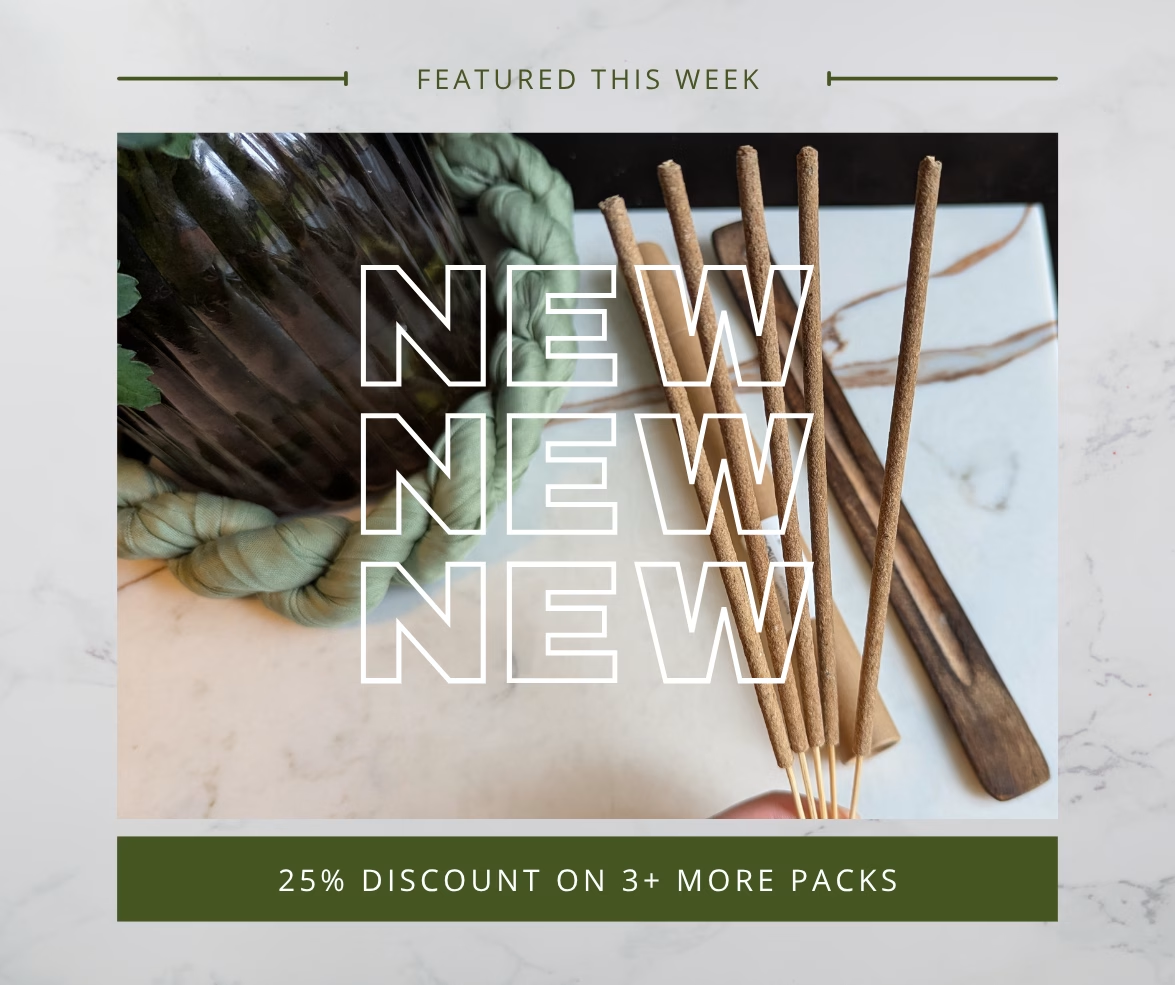
Limited Offer: Save 25% when you buy 3 or more packs of Real Frankincense Incense Sticks at KohẓenOfficial
Authentic, ritual-grade aroma. These Real Frankincense Incense Sticks carry the bright citrus lift, soft evergreen clarity, and warm honeyed base that define Hojari frankincense.
Made at source, with real resin.Sourced from Oman where they’re produced using real Hojari frankincense resin.
Clean, convenient use. About 90 minutes per stick, gentle smoke, stop–start relight with no bitterness or sourness: perfect for modern flats and daily rituals.
Ethical in nature.10% of sales support humanitarian aid initiatives across West Asia.
Excellent value. With the 25% multi-buy, you get hours of calm at a very fair cost per session, for real Hojari frankincense resin.
Ready to try the real thing?25% off when you buy 3+ → KohẓenOfficial
What “Real” means here (and why it matters)
“Pure”, “Natural” gets thrown around a lot in incense marketing, however very rarely do you find incense that uses the raw ingredients described. For me, Real Frankincense Incense Sticks means three things:
Real resin. These sticks use genuine Royal Hojari Boswellia sacra resin from Dhofar, Oman; not a perfume that imitates frankincense.
Real provenance. They’re made in Oman. I source them at origin and bring them to the UK; no vague white-label, or Chinese or Indian replicas.
Real, sacred profile. Because they use authentic Hojari resin, the scent is the one you know from churches, mosques and temples, clean, uplifting, ritual-grade, not powdery perfume, or cheap fragrance oils.
The result is simple: when you light these Real Frankincense Incense Sticks, they smell like rich, organic, Hojari frankincense, not like something pretending to be it.
Ancient Origins of Incense Sticks
Incense – aromatic plant materials that release fragrant smoke when burned – has been used by humans for thousands of years. The very word incense comes from the Latin incendere, meaning “to burn,” reflecting its early ritual uses. In ancient Egypt, priests burned incense resins like frankincense and myrrh during fumigations and religious ceremonies, even placing these precious resins in tombs to honor the dead.
Incense also took on spiritual importance in ancient India and China. The practice can be traced to India’s Vedic period, where offerings of incense were thought to carry prayers and wishes to the divine realm. By around 2000 BC, incense burning had spread to China for use in worship and prayer, with blends of herbs and woods like cinnamon and sandalwood perfuming early temples.
Over time, different cultures innovated new ways to enjoy incense. Indirect-burning incense (like raw resin on charcoal) was common in the ancient world, but it requires constant heat. Eventually, the idea of direct-burning incense sticks emerged, likely in South Asia, to make incense more convenient. An incense stick (often called a joss stick or agarbatti) is a slim stick – traditionally of bamboo – coated in a mixture of ground aromatic materials and a binding paste.
This format, which may have originated in ancient India, allows the incense to smolder on its own once lit. Incense sticks gained popularity because they are easy to light, safe, and continuously release fragrance for an extended period. Burning a single stick became an integral part of Hindu puja rituals and Buddhist and Taoist practices across Asia. By the 14th century, even Japanese samurai were known to perfuse their helmets with incense, and the Japanese developed Kōdō, the art of incense appreciation. In short, incense sticks took hold because they provided a simple, self-contained way to enjoy the mystic aromas that people had valued for millennia – whether to purify spaces, please the gods, or simply relax the mind.
Unboxing & First Impressions
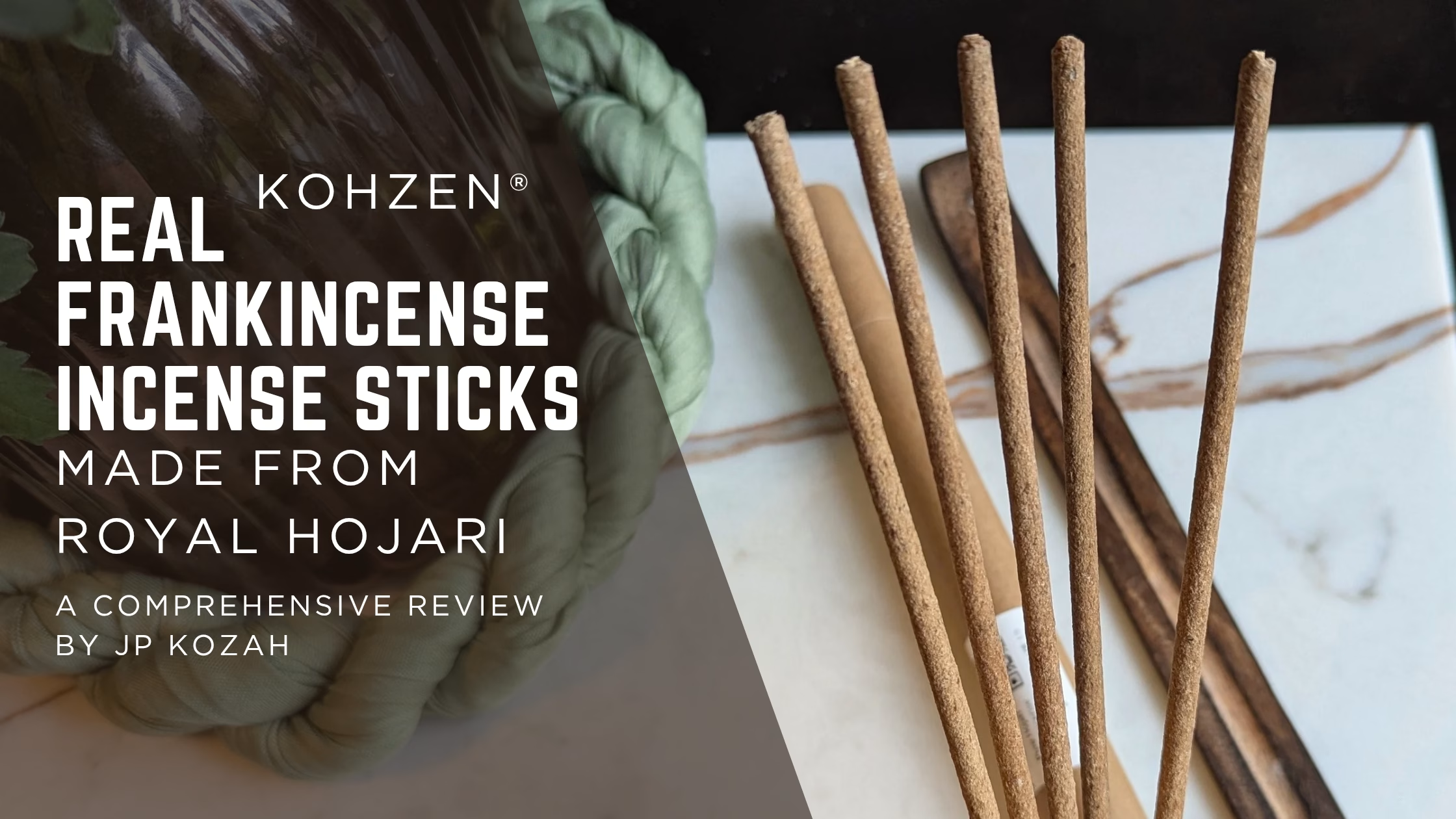
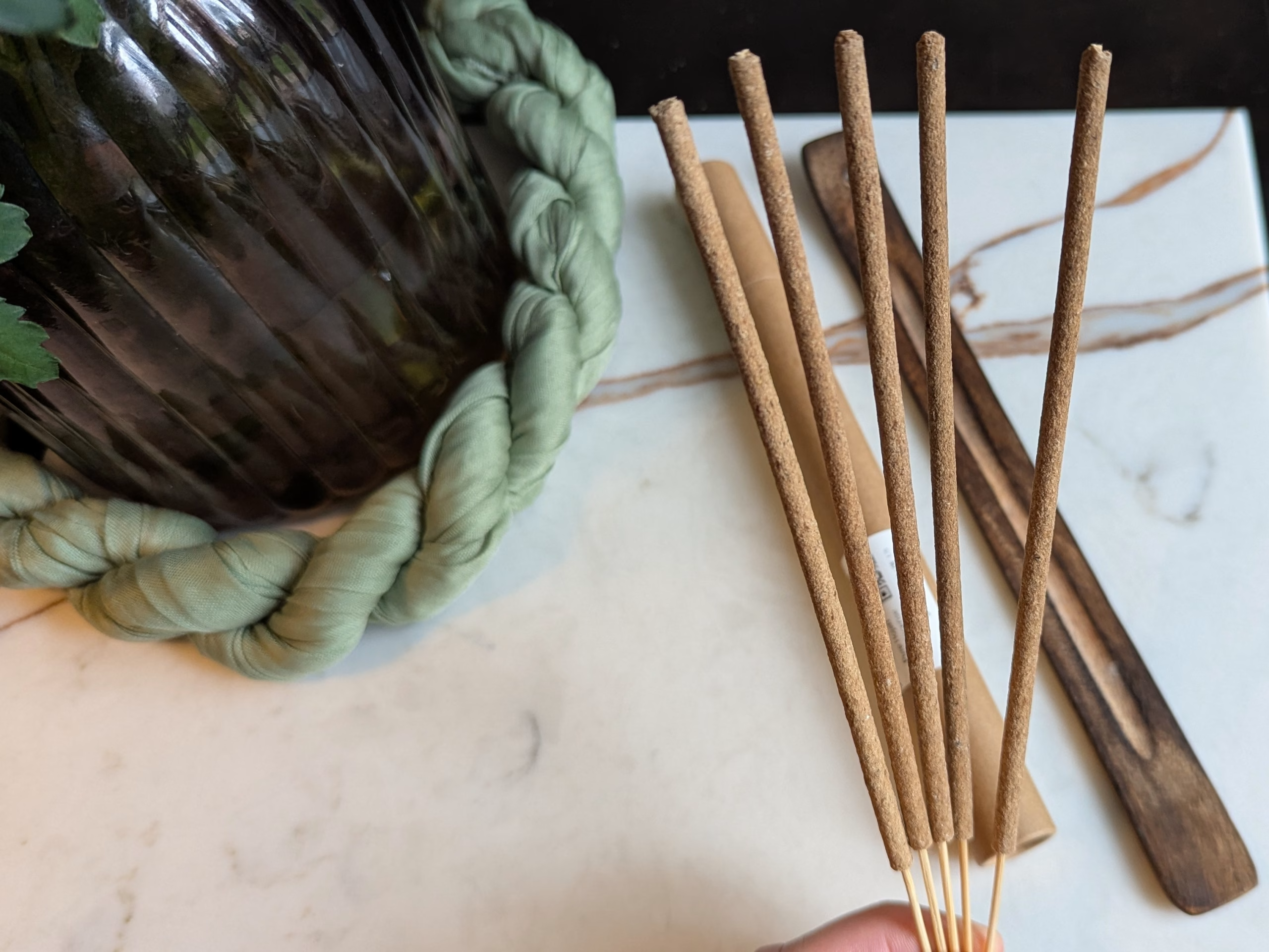
Image 1 — Close-up of the sticks
Opening the tube, you immediately catch a subtle citrus-resin sparkle even before lighting — a tell-tale sign of real frankincense resin content.
A close look at Real Frankincense Incense Sticks sourced from Oman. The fine resin texture supports a slow, clean ember and a faithful Hojari aroma.
Frankincense: The King of Incense Resins
Among all incense materials, frankincense has long stood out as the most esteemed. Frankincense is the dried aromatic resin from Boswellia trees native to the Arabian Peninsula and parts of Africa. In particular, the species Boswellia sacra grows in Oman, Yemen, and Somalia, producing the resin known as frankincense (or olibanum, luban in Arabic). Throughout antiquity, frankincense was not only treasured – it was treasure.
At certain points, this resin was literally worth its weight in gold: in the ancient world frankincense was valued even more highly than gold. Its trade brought immense wealth to Arabian cities. By around the 6th century BC, a vast Incense Trade Route was carrying frankincense from southern Arabia (modern Oman/Yemen) by camel caravan to the Mediterranean and beyond. Egyptian pharaohs, Babylonian kings, and Roman emperors all coveted its sweet smoke. In fact, Oman became legendary as the land of frankincense – a place so abundant in this “white gold” that its very air was said to be perfumed by the resin-bearing trees.
Why was frankincense so prized? Part of the answer lies in its rich spiritual heritage. Frankincense was a key ingredient in sacred ceremonies across numerous ancient religions. The Hebrew Bible records frankincense as a component of holy incense offered in the Temple of Jerusalem (Exodus 30:34–38), and it was burned to accompany prayers, with its white smoke believed to carry messages to the heavens.
In Christianity, frankincense famously appears in the New Testament: the Gospel of Matthew recounts that one of the gifts brought by the Magi (wise men) to the infant Jesus was frankincense, symbolizing divine worship. Early Christians adopted its use; to this day, Catholic and Orthodox churches burn frankincense during Mass and other rites, swinging ornate censers that release the resin’s fragrant smoke in a visual metaphor of prayers rising upward. The scent of frankincense thus became deeply associated with divinity, healing, and solace across cultures.
Frankincense’s appeal is not only spiritual but also sensorial. Good frankincense resin, when burned, emits a uniquely uplifting aroma – a warm, balsamic sweetness with notes of citrus and pine. Ancient descriptions and modern perfumers alike have struggled to capture its complex profile, often describing it as “honeyed but not cloying, with an austere note of pine…rich yet slightly astringent, with hints of lime and amber”.
This inimitable fragrance, instantly recognizable once experienced, helped carry the fame of Arabian frankincense across three continents over thousands of years. Small wonder that Oman’s frankincense was regarded as a gift of the gods – even the trees that produce it were seen as sacred. In Oman, where frankincense trees grow wild on rocky hillsides, the resin is considered a divine blessing; historically, anyone whose land hosted a Boswellia tree was considered specially favoured by Providence.
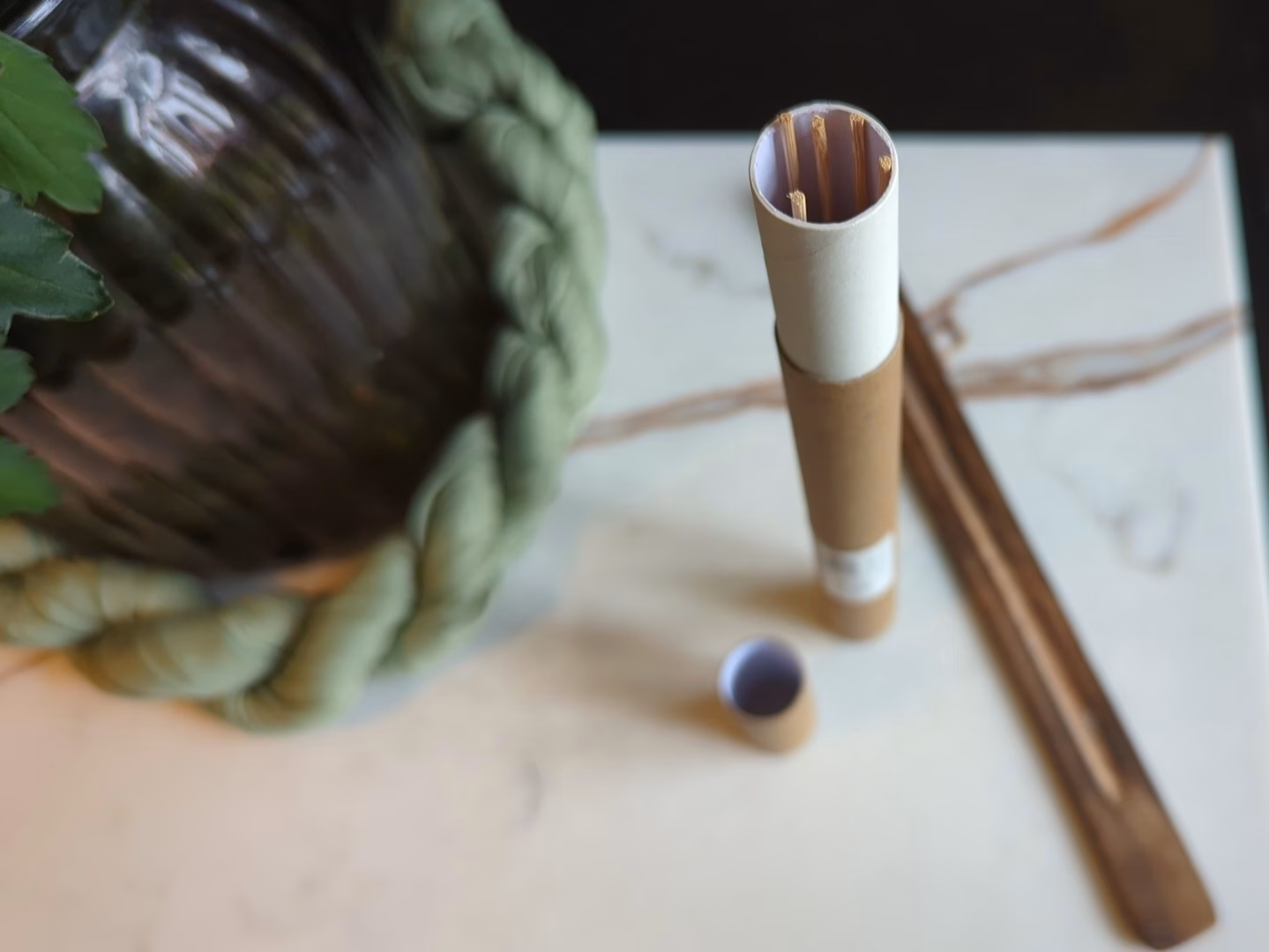
Image 2 — Eco tube packaging
The tube keeps the frankincense sticks safe from knocks and stray odours; handy for a desk drawer or travel bag.
Each pack contains 5 or 10 Real Frankincense Incense Sticks in a recyclable tube that protects against humidity and keeps the aroma pure.
Hojari: The Gold Standard
Just as wine has its Grand Crus and coffee its specialty grades, frankincense too has different varieties and qualities. Hojari (also spelled Hougary or Hawjari) is widely acclaimed as the finest grade of frankincense in the world. This term refers specifically to top-tier resin from Boswellia sacra trees in Oman’s Dhofar region – particularly the inland highlands of that region, which have ideal conditions for producing high-quality resin.
Hojari frankincense is characterized by its large, pale-colored tears (the dried droplets of resin). The most coveted Hojari pieces are opaque white with a slight lemon or greenish hue – sometimes called “Green Royal Hojari” – indicating extreme purity and a rich essential oil content. When burned, Hojari resin releases a brighter and more nuanced fragrance than lower grades: citrusy and ethereal at first, developing into deep amber, woody and lightly sweet balsamic tones. In essence, it is frankincense at its most exquisite.
Omani frankincense, in general, has been esteemed for millennia, but Hojari is the cream of the crop. At the height of the incense trade, demand for Hojari was so great that the ports of southern Oman became the nexus of global frankincense commerce, funneling resin to Egypt, Mesopotamia, Greece, Rome, India, and beyond. Other regions also produce frankincense – for example, in Somalia (often called Beyo or Maydi frankincense) and in India (Salai frankincense). These are true frankincense as well, but connoisseurs have long ranked Omani Hojari at the top for its incomparable aroma and purity.
Culturally and historically, Hojari holds a near-mythic status. It was burned in the temples of ancient Jerusalem and Babylon, carried by camels across deserts to adorn the altars of Athens and Rome, and reserved for the most sacred uses. Omani lore and regional poetry praise it as the fragrance “to which millions of hearts beat on hearing its name,” and locals proudly use it in daily life – from perfuming clothes and homes to flavoring water and even brewing tonic infusions.
In short, Hojari is the gold standard by which all frankincense is judged. Its prestige arises from a confluence of factors: the unique geography of Dhofar (where the monsoon mist nourishes the trees just enough), centuries of trade heritage, and a role in religious rites stretching from the Old World to the New. While many substances can be called frankincense, Hojari is frankincense at its most legendary, imbued with layers of historical, geographical, cultural, and spiritual significance.
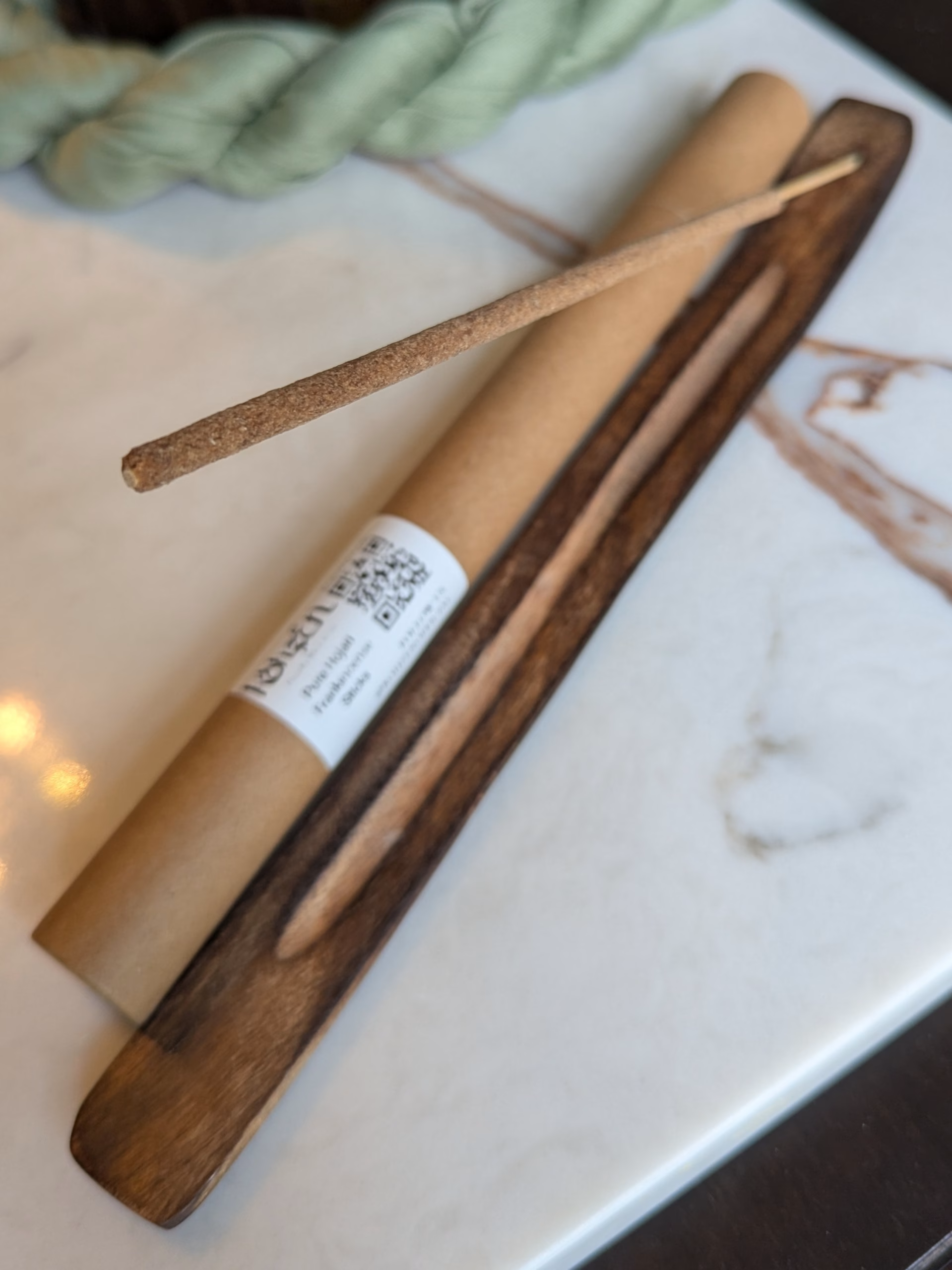
Image 3 — On the holder
Light for 2–3 seconds, blow out, and the ember glows steadily. No fuss, no mess.
Caption:No charcoal, no censer. A single Real Frankincense Incense Stick burns for about 90 minutes with clean, pale smoke.
From Resin to Stick: A Rare Omani Innovation
If frankincense is traditionally burned as raw resin – little golden nuggets placed on hot charcoal – how did frankincense incense sticks come about? This development is surprisingly recent and quite special. In fact, it is only in the last few decades did artisans in Oman (the very heartland of Hojari frankincense) begin to combine their prized resin with the convenience of the incense stick format. One Omani entrepreneur is credited with pioneering this idea, which is why Kohzen have chosen them to source our Real Frankincense Incense Sticks.
By grinding high-grade frankincense resin (like Hojari) into a powder and blending it with natural binders and woods, they could hand-roll it onto sticks – creating a pure frankincense stick that you can simply light and enjoy, without needing charcoal or a special burner. This is a game-changer for frankincense enthusiasts. It means anyone can experience the authentic scent of Omani frankincense in a familiar, easy-to-burn stick form, anytime and anywhere.
These frankincense incense sticks are not your run-of-the-mill incense. As the Omani makers themselves caution, these sticks should not be confused with typical incense sticks on the market: rather these high-quality sticks provide a true, pure, frankincense resin experience. Unlike many commercial incense sticks (which often use perfumed oils or synthetic fragrances to mimic scents), genuine frankincense sticks from Oman contain no synthetic additives at all. They are made with only the frankincense resin and a touch of complementary natural wood to help it burn evenly.
Rolled with pure aromatic resins of precious Hojari frankincense, and woods, free of essential oils and chemicals. The result is an incense stick that, when lit, smells almost indistinguishable from burning raw frankincense tears – woody citrus and sweet balsamic notes filling the air – so much so that if you close your eyes, you will have a difficult time distinguishing this stick incense from burning resin. Each stick typically burns for a long duration (often around 90 minutes per stick) given the density of resin. This slow, potent burn means you get a sustained aromatic experience akin to a resin censer, but with the ease of just lighting a stick and letting it smolder.
Because this is a relatively new fusion of ancient resin and modern format, real frankincense incense sticks remain a rare find. Only a handful of manufacturers in Oman craft them, largely in limited batches, using traditional techniques. Outside of Oman, these sticks are coveted by incense aficionados and often have to be ordered through specialty importers or niche retailers.
In other words, they are not mass-produced commodity incense – they’re an artisanal product born from a particular cultural context. The rarity is part of their charm: when you burn one, you’re experiencing something that few people in the world even know exists. It’s a sensory bridge between past and present, hand-made in the very region that has supplied the world’s frankincense for ages.
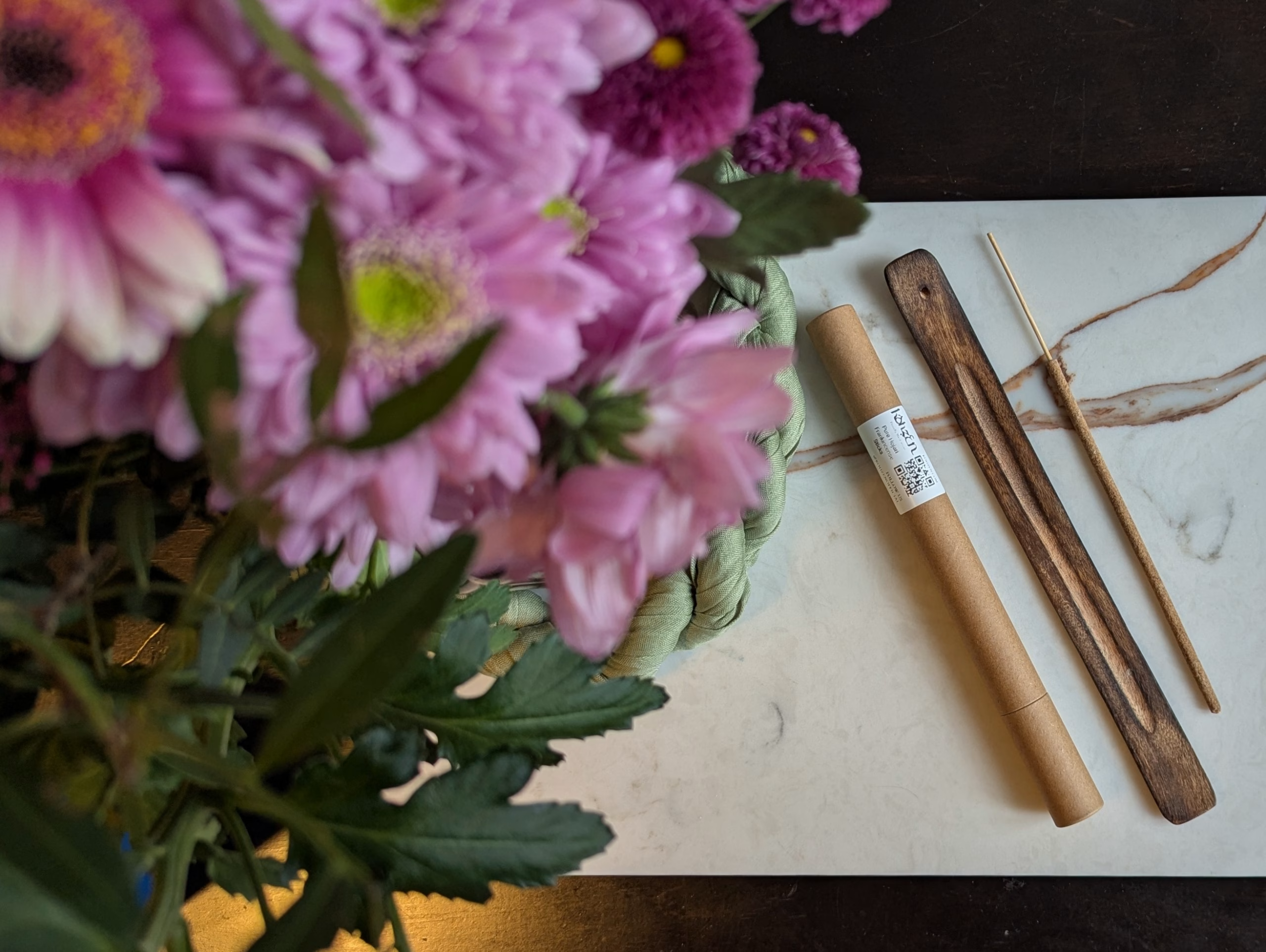
Image 4 — Lifestyle flat-lay
This is where frankincense resin sticks shine: modern homes and daily rituals that seek sacredness without heavy smoke.
Set a gentle ritual for reading, prayer or yoga. Real Frankincense Incense Sticks bring sacred calm to everyday spaces.
Provenance & Ethics: from Dhofar to You
Botanical:Boswellia sacra (Royal Hojari)
Origin:Dhofar, Oman (UNESCO: Land of Frankincense)
Made in:Oman
Imported by: Kohẓen® (London)
Format:5 or 10 Real Frankincense Incense Sticks per tube
Burn time: ~90 minutes per stick (relightable)
Aroma profile: Bright citrus, soft pine clarity, warm honeyed undertone
Social value:10% of sales donated to humanitarian aid across West Asia
Packaging: Recyclable tube with Kohzen branding (holder not included)
Bring origin-authentic Hojari into your home:KohẓenOfficial (save 25% on 3+ packs)
Video: see the calm, steady burn
The video shows what words can’t: no flaring, no harshness, just consistent diffusion and a clean fragrance.
Kohzen’s Real Frankincense Incense Sticks deliver a sublime aromatic experience that clearly sets them apart from generic incense products. Upon lighting a Hojari frankincense stick, many are struck immediately by the “divine fragrance” it releases. The scent is refined and layered – reviewers frequently mention notes of sparkling citrus, amber-like sweetness, and an inviting spice that gently lingers in the room. Unlike heavily perfumed cheap incense, there is nothing cloying or chemical about the smell; it is pure, natural resinous smoke, the same kind that once wafted through ancient temples.
“I have tried other frankincense incense sticks but nothing like Kohzen Hojari frankincense incense sticks. The scent is pure, potent and feels truly calming, filling your space with positive energy.”
This speaks to a common sentiment: once you experience real Omani frankincense, most other incense will feel flat by comparison.
Another striking aspect is the atmosphere of peace and spirituality these sticks can create. For centuries, frankincense has been burned to invite calmness, focus, and sanctity, and that tradition continues in living rooms and meditation spaces today. Users often light frankincense incense sticks during meditation or yoga, finding that the rich scent helps quiet the mind and deepen breathing.
In fact, frankincense smoke has mild psychoactive properties that have been suggested to ease anxiety and promote a meditative state – perhaps validating why it was used in so many religious rituals as an aid to contemplation. After burning, a soft veil of fragrance remains, described as “exquisite” with lingering hints of citrus and sweet spice that can transform the ambiance of a space. It’s no exaggeration to say that a single stick can make an entire room feel like a sacred sanctuary.
One notable different with Kohzen frankincense incense sticks is how cleanly and smoothly the high-quality sticks burn. The sticks sourced from Oman are often thicker and denser than typical incense, and they smolder slowly without producing harsh char or excessive smoke.
“Kohzen frankincense incense sticks last long and remind me of church incense. It transports me to a place of calm and helps me with meditation”.
Indeed, the fragrance of Hojari resin is familiar to many from church ceremonies, temples or West Asian homes and lighting these sticks at can evoke that same sense of reverence and nostalgia – minus the overwhelming smoke that charcoal burning can sometimes produce. Because the sticks are made of true frankincense resin, they smell real. There’s a depth and character to the scent that synthetic “frankincense-scented” products completely miss.
Traditionally, enjoying frankincense meant fetching a charcoal tablet, lighting it until hot, then placing resin chunks on it – a bit of a process (though one with its own charm). Now, you can simply light a frankincense stick and achieve the same aromatic payoff with far less effort and equipment. This convenience does not come at the cost of quality; the experience remains authentic. For those who perhaps shy away from resin incense because of the fuss or the smoke, the sticks are an excellent alternative.
“An ideal option for anyone who knows and longs for the remarkable aroma of Omani frankincense—and wishes to enjoy it without the need for an incense burner.” these sticks bring the elegant, seductive aroma of frankincense to anyone. Whether you’re a long-time frankincense lover or a curious newcomer, the sticks offer a friendly introduction to this ancient fragrance.
Performance (burn, smoke, ash, scent throw)
I test-burn each shipment so results stay consistent:
Burn time: Typically 86–94 minutes indoors with minimal draught.
Relight:Excellent. Extinguish halfway and relight later without sourness or bitterness in the scent.
Smoke:Gentle, pale smoke that carries without overwhelming.
Ash: Fine, compact; drops in neat segments.
Scent throw:Medium in a 12–20 m² room; opens beautifully in hallways and stairwells.
After-scent: A soft resin glow lingers for 1–2 hours post-burn.
Prefer clean, reliable ritual over faff? Choose Real Frankincense Incense Sticks →KohẓenOfficial
Sticks vs. charcoal: which to use, and when?
Real Frankincense Incense Sticks and raw resin on charcoal are complements, not rivals.
Sticks (these):
Zero setup: No charcoal or censer — just a holder.
Gentle smoke: Perfect for flats and daily use.
Consistency: Repeatable results stick-to-stick.
Stop–start:Extinguish and relight cleanly for shorter rituals.
Raw resin on charcoal:
Maximum impact: Big, ceremonial plume — brilliant in large spaces.
Traditional ritual: The censer has its place for high days.
More variables: Charcoal heat, resin size, airflow.
Commitment: Once the coal is lit, you’re in a full session.
If you’re building a daily practice that fits around work, family and shared living, Real Frankincense Incense Sticks give you sacred clarity with no hassle — and you can still reach for charcoal when you want pageantry.
Why Hojari frankincense is better for rituals
Not all frankincense is equal. Hojari resin from Dhofar, Oman is prized because it gives you the sacred, recognisable aroma at low smoke, with a clean finish and reliable consistency — perfect for modern spaces and daily practice.
Smells sacred even in small rooms. Hojari’s bright citrus-and-pine lift “reads” clearly without thick smoke — the same profile you’ll recognise from churches, mosques and temples.
Clean, calm dry-down. Instead of a burnt or bitter tail, Hojari settles into a warm, honeyed note that leaves the air peaceful, not heavy.
Consistent by design. Omani resin is carefully graded, so every stick burns and smells reliably the same.
Start, pause, relight. Real resin smoulders evenly and re-lights without sourness, so you can do short meditations, readings or prayers without committing to a full session.
Heritage you can feel. This is the gold-standard frankincense used across faith traditions — instantly familiar, never perfumey.
Real Frankincense Incense Sticks vs common alternatives
What you care about
Kohzen – Real Frankincense Incense Sticks (Hojari, made in Oman)
Cheap “frankincense” fragrance sticks (no real resin)
✖ Often perfumey/soapy; doesn’t smell like frankincense.
⚠ A bit resinous but dull/woody; lacks Hojari clarity.
✖ Overpowering, burnt-oily tone.
✔ Authentic and powerful.
You get the true sacred aroma, not imitation perfume.
Made where?
✔ Made in Oman with Hojari from Dhofar.
✖ Mass-made; origin rarely stated.
⚠ Mixed or unknown sources.
⚠ Same.
✔ Depends where you buy resin.
Real origin = trust and purity.
Can I relight it?
✔ Yes — stop and relight with no sourness.
✖ Often no — turns acrid after stopping.
⚠ Risky — can go bitter mid-stick.
✖ Not effectively.
✖ No — charcoal is one session.
Control your session = less waste, more use.
Smoke level
✔ Gentle, room-friendly smoke.
⚠ Can be sharp/irritating.
⚠ Sometimes sooty.
✖ Heavy smoke that clings.
✖ Thick ceremonial plume.
Light smoke suits modern homes.
Consistency
✔ High — graded resin + controlled make.
✖ Low — perfume batches vary.
⚠ Mixed — grade/source drift.
✖ Unpredictable.
⚠ Variable — depends on technique.
Reliability builds daily habit and confidence.
Ease of use
✔ Match + holder — no charcoal, minimal ash.
✔ Easy, but disappointing scent.
✔ Easy, average results.
✖ Messy; residue and cleanup.
✖ Needs charcoal, censer, tongs, time.
Simplicity = you actually use it.
How it feels in ritual
✔ Calm, pure, recognisably sacred.
✖ Artificial; breaks the mood.
⚠ Serviceable, not inspiring.
✖ Harsh, smoky.
✔ Powerful, formal.
Fit for quiet reflection and daily peace.
Value for money
✔ ~90 min per stick, reusable, 25% off 3+.
✖ Short burns; poor aroma = false economy.
⚠ Cheaper materials, weaker scent.
✖ Low value after mess/fatigue.
✔ Great impact; high prep cost.
Real quality gives hours of calm, not minutes of frustration.
Ethical impact
✔ 10% donated to humanitarian aid; recyclable tube.
✖ None stated.
✖ None.
✖ None.
⚠ Varies.
Your purchase does good and feels good.
In short: Most look-alike sticks are fragrance-dipped and can’t deliver the sacred frankincense experience — they’re hard to relight and often disappoint. Kohzen’s Real Frankincense Incense Sticks are made in Oman from real Hojari resin, burn cleanly, re-light beautifully, and bring the unmistakable ritual aroma into everyday life — without the faff.
Try them with 25% off when you buy 3+ packs →KohẓenOfficial
How I use Real Frankincense Incense Sticks (everyday rituals)
Morning clarity (10–15 minutes): Light while you plan the day; extinguish once your list is done.
Focused work (30–45 minutes): The evergreen heart supports deep reading or writing.
Prayer/meditation (full burn): Let a stick run to completion to mark sacred time.
Purifying a room: Before guests arrive or after a long day, one frankincense resin stick resets the atmosphere.
Evening wind-down: Dim lights, soft music, and the honeyed dry-down to close the day gently.
Tips for best results
Use a stable holder (ceramic or wood) with a long ash channel.
Ventilate lightly if smoke-sensitive; even a cracked window helps.
Extinguish safely by pressing the ember into clean sand or an ashtray — never water.
Relight cleanly by tapping away loose ash at the tip first.
Store in the tube to protect from humidity and stray odours.
Pair with stillness now and then; the scent reveals more in quiet.
Who it’s for (and who it isn’t)
Ideal for:
Anyone who wants the authentic “churchy” frankincense experience at home
Scent maximalists trying to fill very large halls (use charcoal resin)
People who prefer floral or sweet perfumed incense (these are resin-led)
Those who must avoid any smoke (consider our Frankincense Infusion Oil instead)
Value & Longevity (and the 25% multi-buy)
One tube contains 5 or 10 Real Frankincense Incense Sticks — ~7.5-15 hours of burn time. Because you can pause and relight, a single stick covers multiple short sessions. With 25% off when you buy 3+ packs, you can keep a tube at home, one at work, and one to gift,
Burn on a heat-proof surface and never leave unattended.
Keep away from children, pets, flammables and draughts.
Ventilate lightly after use.
If pregnant, have respiratory conditions or use medical oxygen, seek medical advice before burning any incense.
Sustainability & Social Value
Kohzen is small-batch and values-driven. We tell the whole story — plants, places, people — and we donate 10% of sales to humanitarian aid across West Asia. Our packaging for Real Frankincense Incense Sticks is recyclable, and we choose partners who respect the ecology and heritage of Dhofar.
The Enduring Allure of Authentic Frankincense
Frankincense incense sticks represent a beautiful convergence of old and new – marrying a time-honored resin with a convenient format beloved worldwide. In each stick, there is a story. It’s the story of Oman’s windswept groves of Boswellia trees, tapped for their “tears” of aromatic sap as was done in antiquity. It’s the story of temple priests and herbalists across civilizations who kindled frankincense to cleanse spaces, honor gods, and heal the body and soul.
It’s the same resin that perfumed the halls of Pharaohs, that Roman emperors once hoarded, and that inspired wise men to travel across deserts with gold and myrrh in tow. Now it has been given new life as a simple incense stick – easy to share, yet retaining all the depth of its heritage.
When you light a true Hojari frankincense stick, you aren’t just “scenting a room.” You are participating in a tradition that spans continents and ages. The curl of sweet smoke rising from that stick connects you to rituals in ancient Egyptian temples, Vedic fire offerings, and the frankincense-laden air of medieval cathedrals. It’s a little bit of history ignited anew.
And at the same time, it’s a luxury of the present moment – a chance to slow down and savor an aroma that brings peace and clarity in our hectic modern lives. Hojari frankincense, the gold-standard resin, ensures that this experience is second to none: its bright, ambered fragrance can turn an ordinary evening at home into something transcendent. No synthetic substitute or lower-grade incense can truly compare to the real thing.
In conclusion, frankincense incense sticks offer both the novice and the connoisseur a remarkable product: one that functions as a daily pleasure and a living compendium of history. They remind us why incense became popular in the first place – for its power to transform atmosphere and mindset – and they deliver that power in its most authentic form.
The fact that they are rare, crafted by a few specialists with Omani frankincense, only adds to their appeal as something genuine and special. For anyone seeking to deepen their appreciation of incense or simply to enrich their home with a truly legendary fragrance, these sticks come highly recommended. The Hojari frankincense incense stick is more than a product to review – it’s a little piece of ancient wisdom and luxury, bound on a stick, waiting to share its sacred smoke and storied scent with you.
Final thoughts — why choose Real Frankincense Incense Sticks from Oman?
Because authenticity changes everything. Real Frankincense Incense Sticks made with Hojari resin don’t just smell pleasant — they feel right. They echo the same sacred aroma used for centuries across churches, mosques and temples, translated into a modern, convenient format that you can use every day. If you’ve been let down by “frankincense” sticks that smelled like perfume, step up to the real thing.
Experience the gold standard. Real Frankincense Incense Sticks — 25% off when you buy 3+ →KohẓenOfficial
FAQ: Real Frankincense Incense Sticks
Q1. What exactly are Real Frankincense Incense Sticks?
A. Real Frankincense Incense Sticks are made in Oman from authentic Hojari Boswellia sacra resin (the “gold standard” of frankincense). They’re not perfume-dipped sticks; they’re frankincense resin sticks designed to burn slowly and release the true, sacred frankincense aroma recognised in churches, mosques and temples.
Q2. What makes them “real” compared with ordinary frankincense sticks?
A. Many “frankincense sticks” use synthetic fragrance on a base. Real Frankincense Incense Sticks contain actual frankincense resin (Hojari), so the aroma is naturally citrus-bright with pine clarity and a honeyed, devotional warmth. No imitation perfume, no harsh chemical tail.
Q3. Why Hojari? What makes it the gold standard?
A. Hojari frankincense grows in Oman’s Dhofar region and is famed for clarity, purity and balance: lemon-like lift, soft evergreen heart, and warm ambered dry-down. Historically and culturally it’s the benchmark frankincense—widely used in ritual and prized for its refined scent.
Q4. Where are these frankincense resin sticks made and who sources them?
A. They’re made in Oman and sourced directly at origin by Kohzen. We don’t perfume or white-label generic sticks; we import Omani Hojari frankincense sticks with a traceable story.
Q5. What do Real Frankincense Incense Sticks actually smell like?
A. Expect a three-phase arc: a sparkling citrus opening, a cleansing pine/evergreen middle, and a honeyed resin finish that feels calm and contemplative. It’s the authentic “churchy” frankincense profile—clear, uplifting and never cloying.
Q6. How long does one stick burn? Can I pause it?
A. Around 90 minutes per stick in still indoor air. You can extinguish and relight without sour notes: gently press the ember into clean sand/ash, let it cool, tap away loose ash, and relight later.
Q7. Do I need charcoal or a censer?
A. No. Real Frankincense Incense Sticks are direct-burning—just a safe holder and a match. If you want a heavy ceremonial plume, raw resin on charcoal is ideal; for daily life, these frankincense sticks are simpler and cleaner.
Q8. How do these compare to burning raw resin on charcoal?
A. Raw resin + charcoal gives maximum throw but needs setup, tools and cleanup. Real Frankincense Incense Sticks offer authentic scent with gentle smoke, instant lighting, stop–start control, and stick-to-stick consistency—perfect for flats and everyday rituals.
Q9. What kind of holder should I use?
A. A stable ceramic or wooden holder with a long ash channel. Place on a heat-proof surface away from draughts, curtains and shelves. Empty ash once cool; never move a burning stick.
Q10. Are Real Frankincense Incense Sticks vegan and free from synthetics?
A. Yes. These frankincense resin sticks use plant-based aromatic materials. No animal derivatives, and no synthetic perfume oils added to imitate frankincense.
Q11. Are they suitable for small rooms and flats?
A. Yes—smoke is gentle to moderate. For smaller rooms, crack a window slightly. One Real Frankincense Incense Stick scents 12–20 m² comfortably without the heaviness of charcoal.
Q12. Are they safe in pregnancy or with respiratory conditions?
A. Always seek medical advice if pregnant or if you have respiratory conditions. If approved, burn briefly with good ventilation and avoid enclosed, unventilated spaces.
Q13. Will they trigger smoke alarms or leave residue?
A. Any amount of smoke can activate sensitive alarms. Ventilate lightly and avoid placing sticks under detectors. With normal use, residue is minimal; keep distance from pale fabrics/walls and ventilate after burning.
Q14. How should I store frankincense sticks and how long do they last?
A. Store inside the tube, cool, dry and dark, away from strong odours. Properly stored, Real Frankincense Incense Sticks keep their aroma quality for 12–24 months+.
Q15. What’s included in a pack? Is a stand included?
A. Each tube contains 5 or 10 Real Frankincense Incense Sticks (approx. 90 minutes per stick). Holder/stand not included. Packaging is recyclable and sealed with Kohzen authenticity.
Q16. Why are Omani frankincense incense sticks rare?
A. Only a small number of makers in Oman produce true frankincense resin sticks in limited batches. It’s an origin craft using prized Hojari resin, very far from mass-market fragrance sticks.
Q17. Best uses: when should I burn a real frankincense incense stick?
A. Short meditations, prayer, yoga, reading, post-cleanse space-reset, gentle evening wind-down, or welcoming guests. Real Frankincense Incense Sticks set a calm, sacred tone without heavy smoke.
Q18. Troubleshooting: my stick won’t stay lit—what can I do?
A. Ensure the tip is glowing before you blow out the flame. Avoid strong draughts. If it stalls, tap off ash, relight for 3–5 seconds, and try again on a more stable, heat-proof surface.
Q19. Do Real Frankincense Incense Sticks smell like church incense?
A. Yes—the aroma is authentically “churchy” because it comes from real Hojari frankincense resin. The same sacred profile is recognised across churches, mosques and temples worldwide.
Q20. What are Kohzen’s ethical sourcing practices and social impact?
A. We source at origin in Oman with traceable supply chains and small-batch partners who respect the Dhofar ecology. Packaging is recyclable, and we donate 10% of sales to humanitarian aid across West Asia. Every tube of Real Frankincense Incense Sticks supports people, place, and cultural continuity.
Q21. Are these suitable if I’m sensitive to strong smells?
A. Often, yes. The smoke from Real Frankincense Incense Sticks is gentler than charcoal. Start with 5–10 minute burns, keep light ventilation, and increase gradually if comfortable. If you must avoid any smoke, consider a non-combustion option (e.g. our Frankincense Infusion Oil).
Q22. How many frankincense incense sticks do I need for a larger space or event?
A. For big rooms, use 2–3 sticks placed apart to distribute scent evenly. For very large halls or outdoor use, raw resin on charcoal gives the strongest plume. Indoors, one stick comfortably scents ~12–20 m².
Q23. Do you add essential oils or fragrance oils to these incense sticks to achieve the scent?
A. No. Unlike other cheaper incense sticks, the aroma of Kohzen Frankincense Incense Sticks comes from authentic Hojari frankincense resin itself. We don’t add synthetic perfumes or essential-oil boosters — that’s why these are Real Frankincense Incense Sticks, not fragrance-dipped imitations.
Frankincense and myrrh have been cherished for millennia as sacred aromatics at the heart of spiritual life. Across ancient Egypt, Mesopotamia, the Arabian Peninsula, the Greco-Roman world, and early Christianity, these fragrant resins played pivotal roles in ritual and religion. In fact, as far back as Egypt’s Old Kingdom (c. 2500 BCE), temple reliefs depict pharaohs offering incense to the gods. Archaeologists have found traces of frankincense resin in pharaonic tombs like Tutankhamun’s, silent evidence of its ritual use to sanctify the dead. From temple altars to palace ceremonies, frankincense and myrrh spiritual uses were remarkably widespread.
These “tears of the gods,” as ancients poetically called them, were burned, buried, and applied in ways meant to bridge the human and the divine. In this in-depth exploration, we take an anthropological and historical journey through seven major spiritual uses of frankincense and myrrh – revealing how these substances’ sacred power was expressed across different civilizations.
(Before we dive in, you can learn more about our mission at Kohẓen on our About page, or explore related topics on our blog and in our Ultimate Guide to Frankincense.)
1. Sacred Temple Offerings: Fragrant Gifts to the Gods
Across the ancient world, frankincense and myrrh were quintessential offerings in temples – their smoke seen as a sacred conduit between mortals and deities. In ancient Egypt, priests burned frankincense at dawn and myrrh at dusk before temple statues of gods. Tomb and temple inscriptions dating over 4,500 years ago show pharaohs presenting cones of incense to gods like Ra and Osiris. The Egyptians believed the fragrant smoke purified the air and delighted the gods, creating a blessed atmosphere for ritual.
In Mesopotamia, similarly, incense was part of daily devotions: Babylonian and Assyrian priests burned imported aromatics on their ziggurat altars to appease the pantheon. A Mesopotamian wisdom text even proclaims that “reverence begets favor” and incense offerings earn divine approval. This ritual of burning incense was so universal that stone altars and incense burners have been found across the Near East. In the incense-rich kingdoms of South Arabia (modern Yemen/Oman), temples housed carved limestone burners inscribed with the names of different aromatic resins – evidence that multiple kinds of incense were offered to the gods. Archaeologists note that from the 5th century BCE to the 1st century CE, such cuboid incense altars were popular in Arabian and Levantine temples.
Not only did incense please the gods; it symbolized prayer itself. The rising smoke was often interpreted as a visible prayer carrying wishes to heaven. Greek and Roman pagans adopted this practice enthusiastically. In the Greco-Roman world, no sacrifice was complete without a handful of frankincense thrown onto the altar fire. The fragrance served a practical purpose – masking the odor of animal sacrifice – but also a spiritual one: to honor the deity with a “noble” scent and smoke offering.
The Roman author Pliny the Elder noted that frankincense was burned at nearly every public temple and state occasion as part of the pax deorum (“peace of the gods”), reflecting the belief that Rome’s prosperity depended on keeping the gods pleased. From humble household shrines to the grand temples of Jupiter or Zeus, incense was the aromatic language of worship. As one historian aptly put it, frankincense in particular became a “technology of communication, a medium for mortals to speak with the gods” – its sacred smoke blurring the line between the material world and the spiritual realm.
2. Funerary Rites and Embalming: Scenting the Journey to the Afterlife
Frankincense and myrrh also held a sacred role in death rituals – employed to honor the dead, preserve the body, and guide the soul’s passage to the afterlife. Nowhere was this more evident than in ancient Egypt, where myrrh and frankincense were indispensable in mummification and burial ceremonies. Egyptian embalmers incorporated these resins into their mysterious recipes for preserving flesh. Modern chemical analyses of mummification balms have detected ingredients like frankincense, myrrh, elemi and dammar resins in New Kingdom and Late Period mummies.
The antimicrobial properties of these substances helped slow decay, while their rich perfume masked odors – a practical benefit noted by Egyptian sources. But beyond practicality, the Egyptians attached deep spiritual meaning to these aromatics. Myrrh, with its blood-like red tincture and antiseptic quality, was associated with the lifeblood and rebirth. Frankincense’s burning smoke, often called the “scent of eternity,” was thought to purify the soul.
During funerals and the 70-day mummification process, priests burned copious frankincense to sanctify the space and invoke the gods’ protection. The Egyptian Book of the Dead includes formulas for “fumigating the deceased with incense” to cleanse them for the journey. Indeed, embalmers were also priests performing rituals: as they wrapped the corpse, they anointed it with perfumed resins and intoned prayers, consecrating the body for eternal life.
Egyptian expedition to Punt during the reign of Hatshepsut. (Hans Bernhard/CC BY SA 3.0)
Figure: Relief from Queen Hatshepsut’s mortuary temple (c. 1480 BCE) depicting the transportation of incense and myrrh trees from the Land of Punt. Egypt’s pharaohs launched expeditions to obtain these sacred resins for temple and funerary rituals, calling Punt “God’s Land”.
Other cultures likewise used frankincense and myrrh to dignify death. In the Greco-Roman world, frankincense was burned during funerals and cremations as a sign of honor and to neutralize the odor of decay. The Romans, especially, were notorious for extravagant use of incense in send-offs for the elite. Ancient historians recount that Emperor Nero reportedly burned an entire year’s harvest of frankincense at the funeral pyre of his wife Poppaea in 65 CE – an act meant to show both love and imperial splendor (though likely an exaggeration).
Roman funeral rites often included myrrh as well: myrrh was sometimes added to the funeral pyre or tomb as an embalming unguent and to symbolize the sweetness of the afterlife. In Greek tradition, myrrh (called muron, from which the word “myrrh” derives) was a common ingredient in burial oils. It was used to anoint the body of the deceased, a practice that later carried into early Christian burial customs.
Early Christians, for their part, inherited many of these aromatic practices, even as they gave them new meanings. In the first centuries CE, Christians sometimes burned frankincense in tombs and catacombs – ostensibly to purify the air and cover the stench of decomposition, but also as a reverent offering for the dead. (In fact, in antiquity the line between ritual and medicinal use was blurry – incense could be used “for ritual or medicinal purposes,” and often both at once.)
According to the Gospel of John, Jesus’s body was embalmed with myrrh and aloes after the crucifixion – a striking biblical example of myrrh’s funerary importance. Symbolically, early Christians saw myrrh as foretelling mortality and burial, and frankincense as a symbol of divinity (as per the Magi’s gifts).
Many Church Fathers allegorized the rising incense smoke as the prayers of the faithful for the souls of the departed. Thus, through late antiquity, burning incense and myrrh at gravesites or during memorial liturgies became an enduring Christian practice. The spiritual uses of frankincense and myrrh in funerary rites show how deeply these resins were woven into beliefs about death and the hope of something beyond. To ancient peoples, the sweet smoke and balm of these substances were not only temporal deodorants, but sacred tools to cleanse the soul and ensure safe passage to the realm of the divine.
3. Healing and Medicine: Ritual Remedies and Sacred Perfumes
Beyond worship and burial, frankincense and myrrh were highly valued in ancient medicine – often serving as spiritual healing agents in a world where medicine, magic, and religion intertwined. Ancient healers from Egypt to Greece included these resins in dozens of remedies, believing they were gifts of the gods to cure illness. The Ebers Papyrus (c. 1550 BCE), a famous Egyptian medical text, lists myrrh (bal) and frankincense (antyu) in treatments for ailments ranging from wounds and skin infections to stomach disorders.
For example, translations of Ebers indicate myrrh was used to stop diarrhea, ease headaches, and soothe sore gums and toothaches, among other uses. Frankincense (called lebona in some texts) was prescribed to treat throat infections, asthma, and to stop bleeding and vomiting. These prescriptions were often part of incantations or holistic rituals – an ill person might be fumigated with frankincense smoke to expel the “evil spirit” of disease or given a myrrh tincture to drink as both physical medicine and spiritual purification.
The dual spiritual and medicinal role of incense was especially noted in classical sources. The Greek physician Dioscorides (1st century CE) wrote extensively on both myrrh and frankincense in his Materia Medica, describing their healing virtues in almost reverential terms. He noted that myrrh has warming, drying properties, induces calm sleep, soothes inflammation, and can “glue together” wounds. Frankincense, he added, is similarly astringent and useful for treating ulcers, coughs, and stopping bleeding.
(Amazingly, modern science has validated some of these ancient insights: myrrh indeed has antibacterial and wound-healing effects, and frankincense compounds have shown anti-inflammatory and even anti-cancer properties.) Roman encyclopedist Pliny the Elder likewise praised frankincense as a cure-all – he documented that frankincense smoke could be used to counteract hemlock poison and that salves made from frankincense were applied to tumors and sores. The celebrated Persian physician Avicenna (Ibn Sina, 11th century) later recommended frankincense for a “wide range of bodily ailments” as well, reflecting its continuous reputation in the Old World pharmacopeia.
Crucially, in antiquity medicine was not secular – healing rituals often invoked divine help. Incense and holy resins were used to spiritually cleanse the sick and please gods or spirits for a cure. In Mesopotamia, for example, medical texts suggest burning aromatic woods and resins during healing rites to drive out the demon thought to cause the illness. The Greeks and Romans believed in the miasma theory – “bad air” caused disease – so they burned frankincense and other incense to purify the air as a protective measure. Temples of healing, like the Asklepieia in Greece, burned incense to create a sacred, clean environment for patients to sleep and receive dream-healings from the god Asklepios.
The smoke was both a physical disinfectant and a spiritual offering. As one modern historian notes, in the Roman Empire “it was not clear if the burning of incense was for ritual or medicinal purposes… these were not mutually exclusive”. A single frankincense fumigation could be an act of worship, a sanitary measure, and a medicinal therapy all at once.
Myrrh, similarly, was used in antiseptic balms for wounds – such as by Greek soldiers to prevent infection – but applying myrrh could also be accompanied by prayers to healing gods. The spiritual uses of frankincense and myrrh thus extended into healthcare: these resins were seen as sacred gifts that healed the body by means of the divine. Their sweet scent was the aroma of both holiness and health, a bridge between the physical and spiritual aspects of wellbeing.
4. Purification and Protection: Cleansing Spaces, Warding Off Evil
Another key use of frankincense and myrrh across cultures was purification – cleansing people, places, and objects of any defilement or evil influence. Long before germ theory, ancient people sensed that incense smoke had purifying power, both materially and spiritually. In Egyptian religion, incense was called the “fragrance of the gods” and was burned to consecrate sacred spaces. Temple rituals included incensing the altar, statues, and ritual implements to rid them of any negative energy before communing with the divine.
The Egyptians also burned frankincense and myrrh in daily life for protection: for instance, during the mummification process incense smoke was used to neutralize impure forces and sanctify the corpse. Myrrh’s antiseptic properties likely gave it a reputation for “driving away rot,” not just of flesh but of spiritual corruption. Texts indicate that Egyptians believed incense smoke could expel malign spirits – one reason it was commonly used in funerals and tombs, to ensure no evil clung to the tomb that might disturb the deceased.
Mesopotamian rituals also show incense employed as a protective charm. In Babylonian exorcisms, juniper resin (a local stand-in for frankincense) was burnt to chase away demons or ghosts afflicting a person. One Babylonian ritual text prescribes fumigating a house with aromatics to cleanse it of any evil presence. The idea that pleasant fragrance repels evil appears in many cultures – possibly a psychological association of foul odor with decay/evil and sweet odor with divinity/good.
Frankincense and myrrh’s spiritual uses in protection are even recorded in folklore: the ancient Greek historian Herodotus wrote that the Arabians burned storax resin to ward off the “winged serpents” guarding frankincense trees (a mythic explanation for the aromatic smoke). While mythical, it underscores the belief in incense as a protective smoke-screen against dangers.
In the Greco-Roman world, incense was used to purify everything from homes to battlefields. The Romans would fumigate their houses with incense after a death or illness, in the belief it cleansed the air of both disease and malevolent spirits. Temples and civic buildings were regularly perfumed with incense to maintain sacred purity. Notably, frankincense was thought to repel snakes and pests – Pliny mentions that the fumes drive away reptiles – which gave it an added aura of protective power in a literal sense. Incense was also utilized in rituals of oath and covenant; the purified air was seen as a witness to honest intentions, where any lie would be an “impurity” in the holy atmosphere.
These practices continue in some form to this day. In many Asian cultures (hearkening back to ancient Arabian custom), people burn frankincense or myrrh in the home to dispel negativity and invite blessings. For example, in Oman – one of frankincense’s native lands – families still burn frankincense resin daily not only as an air freshener but explicitly “to protect from evil” influences. The resin is placed on hot coals and carried through the house, a tradition reflecting the belief that the aromatic smoke chases away malign spirits or envy.
This enduring custom is a direct descendant of antiquity’s purification rituals. Whether in a Pharaonic temple or a modern living room, the logic is the same: burn incense, clear the air – literally and spiritually. The high frequency of frankincense and myrrh in ancient purification rites solidifies their status as sacred substances that could banish evil, purify the unclean, and create a shield of divine aroma against harm.
5. Royal and State Ceremonies: Symbols of Power and Sanctity
Frankincense and myrrh were not only tools of priests and physicians – they were also entwined with kingship and statecraft in the ancient world. Because of their great value and sacred aura, these resins featured prominently in royal ceremonies, diplomatic gifts, and displays of political power. Rulers used frankincense and myrrh to associate themselves with divine favor and to elevate the pomp of state occasions.
In ancient Egypt, pharaohs – regarded as divine kings – made lavish use of incense in state rituals to underscore their connection to the gods. During the pharaoh’s coronation (Heb-Sed festival or other jubilees), large quantities of incense would be burned before the statues of deities and the new king, symbolically “anointing” the king with the same fragrance pleasing to the gods. Some scholars suggest that the Egyptian pharaoh’s crown may have been perfumed with myrrh oil as part of the installation, though direct evidence is scant.
What is clear is that pharaohs celebrated victories and jubilees by offering incense to the gods on a grand scale, thereby legitimizing their rule as sanctioned by divine scent. Queen Hatshepsut, for example, not only imported live frankincense trees from Punt to plant at her temple, but her inscriptions claim the expedition was commanded by the god Amun and that incense from Punt was offered to Amun as a thanksgiving for her successful reign. In other words, incense served as a royal tribute to the gods for political success.
In Mesopotamia, incense was integral to royal pageantry as well. Cuneiform records from Assyria and Babylon mention kings donating massive amounts of aromatics to temples on the occasion of their coronation or the New Year festivals. The Assyrian King Ashurbanipal listed “containers of frankincense and myrrh” among the treasures he received and offered after military victories. These resins were sometimes part of tribute from vassal states – indicating that to give frankincense or myrrh to a king was to acknowledge his exalted status (since those gifts were fit for gods). When foreign dignitaries met, the exchange of expensive incenses was a common gesture of goodwill and mutual respect in the Near East.
The Greco-Roman world provides many vivid examples of incense in state ceremonial use. Roman emperors adopted the Eastern custom of requiring offerings of incense as a test of loyalty and reverence. Subjects throughout the empire were expected to burn a pinch of frankincense before the emperor’s image or altar of the Imperial cult, as a token of allegiance to Rome.
In the 3rd century, refusal to offer incense to the deified emperor was one trigger for the persecution of Christians – illustrating how incense had become entwined with politics. For instance, under Emperor Decius (250 CE), citizens had to obtain a certificate proving they had sacrificed (often just by burning incense) to the Roman gods and the Emperor’s genius. Those who would not burn incense (e.g. many Christians) were deemed disloyal. Thus, a simple resin became a political litmus test and symbol of the state religion.
At the same time, Roman rulers themselves embraced incense as part of their majestic image. Triumphal processions that celebrated military victories featured brazier after brazier of exotic incense carried by priests – enveloping the parade in divine-smelling smoke to signal the gods’ approval of the new conquests. During imperial audiences or banquets, censers burning frankincense would announce the presence of the emperor, almost like a perfumed aura of authority. Some ancient writers describe how entering the throne room of an Eastern king or Roman Caesar was accompanied by a whiff of incense, giving the impression that the ruler literally breathed a more rarefied air than ordinary mortals.
Myrrh, too, had its place in royal ritual, often in the form of sacred anointing oils. While the practice of anointing kings is best documented in the Israelite tradition (which we are excluding), other cultures had variants: for example, in Hittite and Mesopotamian rituals, the consecration of a new statue or regalia involved oils that may have contained myrrh or similar aromatics. The continuity of anointing with myrrh is seen later in the Byzantine Empire, where emperors were anointed with holy myron (chrism oil containing myrrh) during coronation – a practice rooted in earlier uses of myrrh as a sign of sanctification and kingship.
Finally, frankincense and myrrh were prime commodities of diplomacy and tribute. The legendary Queen of Sheba (likely a Sabaean or Himyarite ruler) is said to have brought “camels loaded with spices” as gifts to King Solomon – undoubtedly including frankincense and myrrh in that fragrant haul. Classical historians note that when Alexander the Great captured Babylon, he was presented with gold and aromatics from the temples. And when the Romans made contact with Indian and Arabian princes, exchanges of incense and perfume were customary.
All of this underscores that these resins were seen as worthy of kings. Roman writers even lamented how much gold was flowing out of Rome to Arabia to purchase frankincense, pepper, and silk. Pliny estimated the frankincense trade to be so lucrative that the Arabian merchants “valued it equal to its weight in gold”. This drove strategic state actions: the Roman Empire under Emperor Augustus even launched a military expedition (the Aelius Gallus expedition in 25 BCE) to try (unsuccessfully) to take control of the frankincense-growing regions of Arabia. In short, entire wars and alliances could revolve around the incense trade – a testament to how vital these “sacred scents” were to the economy and prestige of ancient states.
6. The Incense Trade Network: A Sacred Commodity Connecting Cultures
The spiritual demand for frankincense and myrrh was so great in antiquity that it gave rise to one of the world’s first global trade networks. In effect, these resins were the economic lifeblood linking Arabia, Africa, and the Mediterranean – often dubbed the Incense Trade Route or Incense Road. By examining this trade, we see how the spiritual uses of frankincense and myrrh conferred immense material value, turning them into commodities as precious as gold and jewels.
The aromatic resin trade dates back at least to the 3rd millennium BCE. The ancient Egyptians, unable to grow frankincense or myrrh in their own land, undertook long voyages to the fabled Land of Punt (likely in the Horn of Africa, e.g. Somalia/Eritrea) to secure these resources. An inscription from around 2500 BCE during Pharaoh Sahure’s reign records an expedition returning from Punt with 80,000 measures of myrrhpbs.org – myrrh being “the most prized commodity from Punt” – alongside ebony, gold, and exotic animals.
The myrrh was destined for making incense and perfume for temples. To the Egyptians, Punt was literally “God’s Land”, known for its sacred incense treespbs.org. Hatshepsut’s famous expedition around 1480 BCE is illustrated in detail on her temple walls: we see rows of frankincense and myrrh trees being transported, massive sacks of resin, and the Puntite chiefs presenting these “marvels” to the Egyptian queen. This shows that by Hatshepsut’s time, obtaining incense was a state-sponsored enterprise of high importance – effectively a holy import to sustain Egypt’s spiritual economy.
As centuries passed, the locus of the incense trade shifted to Arabia. The trees that produce frankincense (various Boswellia species) and myrrh (Commiphora) grew chiefly in southern Arabia and the Horn of Africa, with Oman, Yemen, Somalia and Ethiopia being prime sourcing areas. From around 1000 BCE through 600 CE, the ancient kingdoms of South Arabia – Saba (biblical Sheba), Qataban, Hadramawt, and later Himyar – grew fabulously wealthy by monopolizing the frankincense and myrrh trade. They controlled the caravan routes that carried resin over vast distances.
Classical geographers called this region Arabia Felix (“Fortunate Arabia”) due to its prosperity from aromatics. The incense trade route was not a single road but a network of difficult overland trails and sea passages stretching some 2,000 miles. Typically, camel caravans would haul the dried resin northward from the Arabian coast through inhospitable deserts. One branch went through the Kingdom of Nabatea (with Petra as a major caravan city) and then to the Levant and Egypt. Another branch went east towards Mesopotamia. There were also maritime routes: incense was shipped from South Arabian ports across the Indian Ocean to India, and up the Red Sea to Egyptian ports.
This trade was truly trans-cultural and high-stakes. Greek and Roman authors marveled at how the incense route created booming desert cities in Arabia where none should thrive. The Nabateans, for example, grew rich as middlemen by taxing caravans – the great rock-cut city of Petra owes its existence largely to frankincense profits. Pliny the Elder wrote that frankincense cost its weight in gold in Rome, and lamented the drain of Roman silver to Arabian merchants.
At its height, Roman demand was enormous – it’s estimated that thousands of tons of frankincense per year were imported to satisfy the empire’s rituals and perfumeries. One Roman account claims the South Arabians held annual frankincense auctions, guarded by their priests, and that only a special guild was allowed to tend the incense harvest (to prevent theft of the “divine” commodity). This hints that harvesting incense was itself a sacred duty.
The impact of the incense trade went beyond economics; it facilitated cross-cultural exchange. As the caravans traveled, they carried ideas, art, and religions along with resin. Some historians describe the Incense Road as an early information superhighway linking the Mediterranean world with South Arabia, East Africa, Persia, and India. For instance, the spread of certain deities and symbols (like the Arabian fertility goddesses or the use of incense altars in new cults) can be traced along these routes.
The diffusion of incense itself into Greek and Roman religious practice occurred because traders brought it to new markets; before Alexander the Great, frankincense was a luxury in Greece, but by Hellenistic times it had become mainstream in Greek temples – a direct result of the trade network.
By 600 CE, the incense trade’s golden age waned (due to changes in Roman demand and new sea routes), but its legacy was profound. The sacred resins had, in a very concrete way, linked the spiritual traditions of multiple civilizations. A temple in Thebes, a shrine in Babylon, a church in Constantinople – all could be burning frankincense coming from the same frankincense groves in Oman or Somalia.
This ancient globalism underpinned by spiritual demand is a fascinating chapter in economic and religious history. As one exhibition on the incense trade noted, “for over a thousand years… frankincense and myrrh were the most sought-after forms of incense in the Mediterranean world”, fueling a vast exchange of wealth and culture. The reverence for these resins literally paved the way for international commerce and cultural connectivity in the ancient era. Little wonder the ancients often wrote of frankincense in reverent terms – it was not just a commodity, but a sacred substance that built and bridged empires.
7. Mythology and Symbolism: Divine Origins and Sacred Legends
Finally, to truly grasp frankincense and myrrh’s spiritual significance, we must look at the myths and symbols surrounding them. Ancient peoples wove these resins into their cosmologies and sacred stories, attributing them divine origins and deep metaphorical meaning. Through myth and lore, frankincense and myrrh were characterized as substances not of this world, but gifts from the gods imbued with magical properties.
In ancient Egypt, a beautiful legend held that frankincense was born from the tears of the gods. One epithet for incense was “the sweat of Ra” or the “tears of Horus.” As one modern source recounts, in Oman frankincense is still poetically called “the tears of the gods”. The Egyptians believed that when the sun god Ra first wept, his tears upon hitting the earth transformed into frankincense resin – a divine concretion of sunlight and sorrow.
By burning those “tears,” the Egyptians symbolically returned Ra’s essence back to the heavens with prayers. Myrrh too had mythic status: the deity Osiris was sometimes called Lord of Myrrh, and myrrh resin was associated with Isis’s powers of healing and resurrection. In temple rites, the aroma of incense was literally thought to manifest a god’s presence. One temple inscription calls incense the “breath of the gods,” illustrating how intimately scent was linked to divinity.
Greek and Roman mythology also incorporated these aromatics. The most famous example is the legend of the Phoenix, a mythical bird that dies and is reborn from its ashes. According to Greco-Roman accounts (e.g. by Ovid, Pliny, and later early Christian writers like Clement of Rome), when the Phoenix felt its death approaching, it would build a nest of frankincense, myrrh, and other spices, set it on fire, and be consumed in the flames – only to rise anew from the fragrant pyre.
In this story, frankincense and myrrh are not incidental; they are the essential substances of rebirth. The choice of these resins in the Phoenix myth vividly conveys their symbolic link to immortality and resurrection. The sweet smoke of frankincense and myrrh in the Phoenix’s funeral nest exemplifies purification and transformation – the bird’s soul literally riding the incense smoke to heaven to be reborn. It’s a powerful image that resonated in antiquity; even some early Christian texts adopted the Phoenix as a symbol of Christ’s resurrection, complete with the detail of a nest of myrrh and frankincense.
Meanwhile, various cultural legends explained the origin of frankincense and myrrh trees as miracles or divine acts. The Greeks told one tale of a beautiful mortal woman named Myrrha who was transformed into a myrrh tree; her tears became the myrrh resin, eternally weeping. This myth (recorded by Ovid) assigned a tragic, sacred quality to myrrh – born of love and sorrow, appropriate for its use in burials and lamentations. In South Arabian lore, the gods were said to favor certain mountain groves, causing frankincense to grow there as a sign of blessing.
The fact that frankincense trees grew in remote, harsh environments (rocky cliffs of Dhofar and Socotra) led to beliefs that they were protected by divine or mystical forces. Harvesters in antiquity often performed religious rituals before cutting the tree’s bark, asking forgiveness from the spirit of the tree for taking its “blood.” Thus even the act of obtaining these resins was ritually charged.
In early Christianity (outside the Israelite Temple context), frankincense and myrrh gained new layers of symbolism while retaining their aura of sacredness. The Gospel of Matthew famously narrates how the Magi from the East brought gifts of gold, frankincense, and myrrh to the infant Jesus. Christian tradition interprets these gifts allegorically: gold for Christ’s kingship, frankincense for his divinity (as incense for God), and myrrh for his mortality (as it was used to anoint the dead). This interpretation shows that by the first century CE, people clearly recognized frankincense as emblematic of priestly or divine status and myrrh as a symbol of suffering and healing.
The Book of Revelation later depicts heavenly worship with incense: “the smoke of the incense, with the prayers of the saints, rose before God” – a direct continuation of the old idea that incense smoke = prayers. Church fathers like St. John Chrysostom emphasized that incense itself wasn’t needed by God (in a literal sense) but was a symbol of the pure prayer and the presence of the Holy Spirit. Interestingly, even as early Christians downplayed actual incense burning (due to its pagan associations), they richly spiritualized the concept of incense.
Martyrdom accounts describe the scent of frankincense miraculously filling the arena when a saint died, signifying divine approval. Holy relics were said to exude sweet fragrances of myrrh. And when regular use of incense returned to the Church in later centuries, it was with full symbolic force: the incense at Mass represents the rising of prayers to God and the sanctification of the congregation.
Across these various myths and symbols, certain themes stand out. Frankincense and myrrh are consistently associated with divine presence, purity, sacrifice, and life beyond death. Whether it’s gods weeping resin tears, mythical birds renewing in perfumed flames, or saints leaving a trace of incense in death – the message is that these substances are not ordinary. They occupy a space between the physical and spiritual realms. The ancients experienced their intoxicating aroma and saw a metaphor for the transcendent. In a real sense, frankincense and myrrh were media for storytelling about humanity’s relationship with the sacred.
They told of humans yearning to connect upward (the smoke to heaven) and of gods reaching downward (heavenly “tears” solidified on earth). In the great tapestry of world mythology and religion, frankincense and myrrh are golden threads that symbolize the sacred power to heal, to protect, to honor, and to transform. Their enduring presence in spiritual rites across so many cultures speaks to a universal human intuition: that a simple fragrance can contain profound meaning, and that through ceremony with these gifts of nature, one might draw a little closer to the divine.
FAQ
Q1. What are the main spiritual uses of frankincense and myrrh?
Frankincense and myrrh were used in ancient rituals for worship, purification, healing, funerary rites, and royal ceremonies. Their smoke symbolised prayers rising to the divine, while their oils and balms were applied to cleanse and protect both body and spirit.
Q2. Why were frankincense and myrrh considered sacred in ancient cultures?
Ancient peoples believed the fragrance of frankincense and myrrh connected humans with the divine. Their rarity, uplifting scent, and ability to purify spaces gave them deep symbolic meaning as gifts fit for gods and kings.
Q3. How were frankincense and myrrh used in ancient Egypt?
In Egypt, frankincense and myrrh were essential in temple offerings, mummification, and healing. They were burned to honour the gods and used in balms to preserve the body for the afterlife, symbolising purification and rebirth.
Q4. Did the Greeks and Romans use frankincense and myrrh?
Yes. In the Greco-Roman world, frankincense and myrrh were burned during sacrifices, state rituals, and funerals. They were also key ingredients in perfumes and medicines, valued for both their fragrance and healing properties.
Q5. What is the difference between frankincense and myrrh?
Frankincense comes from the Boswellia tree and produces a bright, citrus-woody scent used for uplifting and purification. Myrrh, from the Commiphora tree, has a deep, resinous aroma associated with healing, grounding, and protection.
Q6. How did frankincense and myrrh shape ancient rituals?
They served as universal symbols of sanctity, healing, and kingship. Burning incense or anointing with myrrh created sacred space and affirmed the presence of the divine in temples, royal courts, and homes alike.
Q7. Where did ancient civilizations source frankincense and myrrh?
Both resins originated from the Arabian Peninsula and the Horn of Africa, especially modern Oman, Yemen, Somalia, and Ethiopia. They were traded along the ancient Incense Route, connecting Arabia to Egypt, Mesopotamia, and Rome.
Q8. Are frankincense and myrrh still used spiritually today?
Yes. They remain central in religious traditions around the world. Many people burn frankincense or myrrh during prayer, meditation, or cleansing rituals, continuing a practice that dates back over 5,000 years.
Final Reflections on Frankincense and Myrrh Spiritual Uses Across Civilisations
From the foregoing journey through ancient civilizations, it is evident that frankincense and myrrh were far more than commodities – they were pillars of spiritual life that left an indelible mark on human history. These aromatic resins served as a common thread weaving together diverse cultures’ approaches to the divine. In temples, they were the medium of prayer; in tombs, a promise of rebirth; in sickrooms, a purifier of body and soul; in royal courts, a fragrant mantle of authority; and along trade routes, a bridge between far-flung peoples.
The frankincense and myrrh spiritual uses we have explored reveal how deeply these substances satisfied the human longing for connection to something higher. Their smoke carried aspirations, their balm healed and preserved, and their very existence in harsh climes spoke of nature’s miracles.
Even after the ancient empires fell, the legacy of frankincense and myrrh continued. They found a lasting home in religious traditions – from Catholic and Orthodox incense rites to Ayurvedic and Chinese medicine – proving that their appeal transcends time and culture. Today, when you light a piece of frankincense or catch a whiff of myrrh, you are participating in a ritual act that unites you with pharaohs, priests, and physicians of ages past.
It’s a reminder that the sacred power of scent is one of humanity’s oldest shared experiences. As modern research begins to validate some of their medicinal benefits and psychological effects (calming the mind, elevating mood), one might say science is finally catching up with what ancient wisdom long held: these resins uplift the spirit.
In a modern secular world, the rich anthropological and historical tapestry of frankincense and myrrh invites us to rediscover a sense of wonder. They ask us to slow down and experience the sensory bridge between material and spiritual. This is perhaps their greatest gift – the ability to transform a simple act (burning incense, anointing with oil) into something imbued with meaning and mindfulness. As you have seen, empires literally rose on the smoke of frankincense. And while times have changed, the mystique of these aromatics remains. Whether you are drawn by their biblical fame, their exotic origin, or their therapeutic qualities, engaging with frankincense and myrrh can be a way to connect with a profound heritage of spiritual practice.
In summary, frankincense and myrrh’s story is one of continuity amid change – a story of how two humble tree resins captivated the human spirit across continents and millennia. The ancients may have described them as divine tears, but perhaps it is we who are moved to tears by the sublime fragrance and history they carry. Their sacred power endures in every waft of incense smoke curling toward the heavens.
Key Takeaways:
Universal Sacred Use: Frankincense and myrrh were used in almost every ancient civilization’s spiritual rituals – from Egyptian temples and Mesopotamian ziggurats to Greek and Roman altars – as offerings to deities, symbolizing prayer and devotion. Their smoke was viewed as a divine conduit, carrying prayers to the heavens.
Funerary and Afterlife Rites: Both resins played critical roles in death and burial practices. Egyptians used myrrh and frankincense in mummification balms and burned incense during funerals to purify the dead and aid the soul’s journey. Greco-Roman elites likewise burned incense at cremations (e.g. Nero’s legendary use of frankincense) to honor the dead and mask odors, while early Christians continued using incense and myrrh to anoint bodies, signifying resurrection hope.
Healing and Medicine: Ancient medical texts show frankincense and myrrh were prized remedies for many ailments – used to disinfect wounds, treat infections, calm digestion, and more. They were often employed in spiritual healing rituals, fumigating the sick to expel “evil” and invoking divine help. Notably, Dioscorides and Pliny lauded frankincense as a panacea, and modern science has confirmed antibacterial, anti-inflammatory properties in both resins.
Purification and Protection: Across cultures, these aromatics were burned to cleanse sacred spaces and ward off malign forces. Egyptians and Mesopotamians believed incense smoke dispelled demons and impurity. The practice of smudging with frankincense continued in folk traditions (e.g. burning frankincense in homes to protect against evil in Arabia). The resins’ pleasant fragrance was thought to create a holy environment that negative entities could not tolerate.
Royal and Ritual Power: Frankincense and myrrh were symbols of prestige, used in royal ceremonies and state religion. Ancient kings offered incense to legitimize their rule under divine favor, and incense frequently accompanied coronations, treaties, and victory parades. In Rome, incense became entwined with emperor worship – a political tool of loyalty (subjects had to burn incense to honor the Emperor). The great value of these resins made them diplomatic gifts and tribute items fit for kings, reinforcing their image as “gifts of kings and gods.”
Incense Trade and Cultural Exchange: The high spiritual demand led to the Incense Trade Route, connecting Arabia, Africa, and the Mediterranean for over a millennium. South Arabian kingdoms grew rich as suppliers, and caravans carried frankincense and myrrh thousands of miles. This trade spread not only goods but also religious ideas (e.g. incense-burning practices) between cultures. Frankincense was literally worth its weight in gold, motivating expeditions and even military conflicts for control of the source regions.
Mythology and Symbolism: Ancients wrapped these resins in mythic origins – calling frankincense the “tears of the gods” and featuring them in legends like the Phoenix myth of renewal in a nest of frankincense and myrrh. Such stories highlight their symbolism of divinity, immortality, and sacrificial offering. In Christian tradition, frankincense and myrrh gained allegorical meanings (frankincense for Christ’s divinity, myrrh for his mortality), cementing their sacred status. Throughout lore, they represent a bridge between the mortal and divine – physical materials carrying spiritual significance.
Frankincense and myrrh’s enduring legacy in spiritual practice is a testimony to their unique capacity to inspire reverence. If you’re interested in experiencing these ancient aromatic treasures yourself – whether for meditation, ceremonial use, or personal wellness – consider bringing them into your own life. Discover the purest Hojari frankincense, myrrh resins, and related products at our KohẓenOfficial Etsy shop, where we offer sustainably sourced incense worthy of its storied history. Embrace the sacred smoke and find a moment of connection with the timeless rituals of our ancestors.
(Ready to explore or purchase authentic frankincense and myrrh? Visit the KohẓenOfficial Etsy shop for premium resin incense and more!)
Frankincense in the Bible is far more than an exotic spice or aromatic resin – it holds a sacred significance stretching from the Old Testament to the New Testament. This precious substance, derived from the dried sap “tears” of Boswellia trees in Arabia, was treasured as holy incense in ancient worship and valued as a gift fit for kings. Throughout Scripture, frankincense appears in laws of worship, poetry, and prophecy, each time laden with symbolism.
It rises in Temple smoke symbolising prayer and divine presence, it is offered to baby Jesus by the Magi in a gesture rich with meaning, and it even features in love poetry and visions of distant lands like Sheba. Yet many of these deeper truths remain little-known. In this pillar exploration, we unveil seven sacred truths about frankincense in the Bible – from its theological symbolism and ritual use, to its trade origins and archaeological evidence – all backed by historical and scriptural evidence. (As you read, you’ll find internal links to our Kohzen blog for further exploration, plus authoritative external sources to support each point.)
Reference #1: Frankincense in the Bible Was a Holy Incense in Ancient Worship
In the Bible’s earliest ritual instructions, frankincense holds pride of place as a holy incense ingredient. God commanded Moses to prepare sacred incense for the Tabernacle using a mixture of frankincense, stacte, onycha, and galbanum, seasoned with salt.
This perfumed blend, called ketoretin Hebrew, was burned morning and evening on the altar of incense as a pleasing offering to God (Exodus 30:34–36). Pure frankincense was also sprinkled on certain sacrifices – for example, on grain offerings and the weekly Bread of the Presence – as a symbol of dedication. When burned, its resin produces a white smoke with a rich perfume, hence the Hebrew name lebonah (“white”) referencing its milky droplets. The ancient Israelites considered this aroma holy. Only priests could offer frankincense in the sanctuary, and its use outside of worship was forbidden (Exodus 30:37–38). The significance is clear: frankincense was reserved for the worship of Yahweh, signaling the sanctity of every ritual where its fragrance arose.
Even after the Temple was built in Jerusalem, priests continued burning frankincense daily in solemn ritual. This made frankincense a hallmark of biblical worship, marking sacred space with its divine scent. Little wonder that later generations would remember ancient Israel’s faith whenever they smelled this “pure incense”. (Notably, modern frankincense in shops – often from different trees like the Norway spruce – is not the same resin as the biblical frankincense, which came from Boswellia trees.) The Bible’s emphasis on frankincense in worship underscores how central incense was to Judaic spirituality – it was the tangible fragrance of the holy.
Reference #2: Frankincense in the Bible Symbolized Prayer and Divine Presence in Scripture
Burning frankincense was not an empty ritual; it carried profound symbolism in the Bible. The billowing smoke ascending from the altar of incense came to represent prayers rising to heaven and the presence of God among His people. For example, the Psalmist pleads, “Let my prayer be counted as incense before You” (Psalm 141:2), directly linking incense to prayer.
As the fragrant smoke wafted upward in the Temple, worshippers believed their supplications rose with it to God’s throne. Similarly, in the New Testament, people gathered at the Temple’s incense offering hour to pray (Luke 1:10), and the Book of Revelation portrays heavenly beings offering “golden bowls full of incense, which are the prayers of the saints” (Revelation 5:8). Incense also symbolized God’s presence and name. The prophet Malachi envisioned a future where in every place “pure incense” would be offered to God’s Name (Malachi 1:11), showing incense as an emblem of the Divine Name and worship.
Because frankincense was a key ingredient in the sacred incense, it took on this theological meaning. When an Israelite smelled frankincense burning, it was a sensory reminder that God was near and receiving their worship. In Song of Songs, the beloved is described as perfumed with frankincense (Canticles 3:6) coming in “like pillars of smoke”, imagery that evokes a divine procession. Later Jewish tradition and Church fathers often interpreted incense as symbolizing purification and prayer, a practice that continues in many liturgical churches to this day. Thus, one sacred truth is that frankincense in the Bible was a metaphor for spiritual devotion – an earthly fragrance carrying heartfelt prayers to the heavenly realm.
Reference #3: Frankincense in the Bible Was a Gift Fit for a King – and Symbolic of Christ’s Divinity
One of the most famous appearances of frankincense in the Bible is as a gift of the Magi. In the Gospel of Matthew, wise men from the East arrive to honour the newborn Jesus, “opening their treasures, they presented to Him gifts of gold, frankincense, and myrrh” (Matthew 2:11). These were not random trinkets but highly symbolic offerings. In the ancient world, such costly items were standard gifts for a king or even a deity. Gold represented royalty, frankincense was a perfume or incense befitting divinity, and myrrh was a precious anointing oil.
Early Christian commentators saw deep meaning in these three gifts: gold acknowledging Christ’s kingship, frankincense signifying His priestly role and divine nature, and myrrh foreshadowing His suffering and death (as myrrh was used in embalming). This interpretation became popular through the centuries (even reflected in the carol “We Three Kings”).
Frankincense, in particular, was understood to honour Jesus as God Incarnate – since frankincense was used in worship, presenting it to Jesus implied worshipping Him as divine. Indeed, the Old Testament had predicted such homage: the prophet Isaiah foretold a time when nations would come “bearing gold and frankincense” and proclaiming the praise of the Lord. The Magi’s actions fulfilled this prophecy in a remarkable way. Beyond symbolism, frankincense may also have had practical significance for the Holy Family.
Researchers today note that frankincense contains compounds (like incensole acetate) that are thought to have medicinal and anti-inflammatory properties. Some scholars speculate the wise men, coming from regions familiar with frankincense’s healing uses, might have offered it as a remedy to protect the infant Jesus’s health. Whether or not the Magi “knew” of its pharmacology, the gift of frankincense clearly communicated that Jesus was no ordinary child – He was King and God worthy of worship. This sacred truth reveals why frankincense is forever linked with the Christmas story and Christian theology about Christ’s identity.
Reference #4: Ancient Trade Routes Brought Frankincense from Sheba (Arabia) to Biblical Lands
Frankincense is mentioned repeatedly in Scripture as coming from the distant lands of the East, indicating its exotic origin and high value. In fact, frankincense trees (Boswellia sacra) did not grow in the Eastern Mediterranean climate; they thrived in the arid mountains of southern Arabia(modern Oman and Yemen) and parts of Somalia and Ethiopia on the Horn of Africa. From these regions, frankincense resin was transported by camel caravan across hundreds of miles of desert.
The ancient Incense Trade Route wound northward from the Arabian Peninsula to the Levant, carrying frankincense, myrrh, spices, gold, and other luxury goods to Mediterranean markets. The Bible preserves clues of this trade network. Isaiah, envisioning tribute flowing to Jerusalem, writes “all from Sheba shall come bearing gold and frankincense” (Isaiah 60:6) – Sheba being the kingdom in South Arabia famed for its incense. Jeremiah likewise asks rhetorically, “What use to Me is frankincense that comes from Sheba?” (Jeremiah 6:20), implying that the Hebrews imported their frankincense from Arabia, particularly from Saba (Sheba). Historically, this is spot on: the Sabaeans of Yemen (biblical Sheba) and their neighbours grew wealthy as middlemen controlling the frankincense caravans.
For over a thousand years (ca. 8th century BC to 6th century AD), South Arabian kingdoms like Saba, Qataban, and Hadhramaut prospered by exporting frankincense and myrrh to Egypt, Lebanon, Cyprus, Greece, and Rome. Arab merchants would gather the resin at Arabian ports and oases, then trek through the Arabian Desert up to Gaza or Damascus. The journey was long and arduous – Roman authors like Pliny note it took 65 stages across the desert – but immensely profitable, with the Incense Route likened to a “caravan army” in scale.
Queen of Sheba’s famed visit to King Solomon (1 Kings 10) also hints at this trade: she arrived with camels bearing spices, gold, and precious stones in great abundance, quite possibly including frankincense among her “balsam oils” (Josephus even wrote that the Queen of Sheba ruled the incense trade). Thus, the presence of frankincense in the Bible opens a window onto the ancient world’s global commerce. It is a sacred truth that the incense offered in Jerusalem’s Temple had travelled hundreds of miles from Arabian groves, connecting the Holy Land to the broader economy of the Near East. This ancient globalisation underscores the extraordinary value frankincense held – literally worth its weight in gold in biblical times.
Reference #5: Frankincense in the Bible Appears in Poetry and Prophecy as a Symbol of Luxury and Holiness
Beyond ritual texts, frankincense graces the poetry and prophetic visions of the Bible, symbolizing the height of luxury, love, and sanctity. The Song of Songs (Song of Solomon) – a biblical book of romantic poetry – twice mentions frankincense in lush imagery. “Who is this coming up from the wilderness like pillars of smoke, perfumed with myrrh and frankincense?” asks Song 3:6, painting a picture of a bride or royal procession enveloped in rich fragrance.
Frankincense here evokes an atmosphere of opulence and sensual delight, fit for King Solomon’s wedding parade or a lover’s arrival. Later, the lover’s garden of spices in Song 4:14 includes frankincense alongside saffron, myrrh, aloes and more – “with all the finest spices”, showing it as one of the most prized scents on earth. This poetic use tells us that ancient Israelites knew frankincense as an elite luxury, a fragrance of romance and abundance.
Prophetic literature likewise casts frankincense as an emblem of holiness and divine worship. We saw Isaiah’s prophecy of nations bringing gold and frankincense to honour God’s glory in Zion. Another striking example is in Malachi 1:11, where the Lord declares that “in every place incense (frankincense) shall be offered to My name, and a pure offering”.
This vision elevates frankincense as a pure gift pleasing to God everywhere – a symbol that true worship (from all nations) would be as fragrant and acceptable as the sacred incense in Jerusalem. In the New Testament’s Book of Revelation, John’s vision of the New Jerusalem includes frankincense in a list of luxury goods traded by the world’s merchants (Revelation 18:13), right alongside gold, spices, and fine crafts. This hints that even by the first century AD, frankincense was still synonymous with wealth and sanctity on a global scale.
Furthermore, frankincense’s presence in prophecy sometimes carried a corrective tone. Through Jeremiah, God chastises the disobedient by saying, “What do I care about incense from Sheba…? Your burnt offerings are not acceptable” (Jer. 6:20). Here, even the finest frankincense from afar could not cover insincere worship – a reminder that ritual fragrance meant nothing without righteousness. Taken together, these poetic and prophetic uses reinforce frankincense’s dual symbolism: it represented the height of earthly value and pleasure, and at the same time the essence of what is consecrated to God. This sacred truth shows the rich metaphorical power frankincense held in the biblical imagination, from love songs to visions of the Messiah’s kingdom.
Reference #6: Archaeology Confirms Frankincense in the Bible (and Beyond)
For centuries, frankincense in the Bible was known only from texts – but modern archaeology has literally sniffed out evidence of its use in ancient worship, affirming the scriptural accounts. One groundbreaking discovery came from a variety of artifacts excavated in the the Negev. At the fortress of Tel Arad (a Judahite site from around the 9th–6th centuries BC), archaeologists uncovered a small shrine with two incense altars. Residue analysis published in 2020 revealed something astonishing: one altar had burned frankincense mixed with animal fat.
This marks the earliest known evidence of frankincense in Judahite worship, and indeed the first proof that the ritual use of imported frankincense – exactly as described in the Bible – was actually happening on the ground. It’s a vivid confirmation that people in the biblical kingdom of Judah were burning true frankincense resin as part of their religious ceremonies, likely to produce the pleasing aroma (the added animal fat would help it burn). The fact that this costly Arabian resin was found in a frontier shrine underscores how valued and widespread its sacred use was.
Other archaeological finds echo frankincense’s presence in the broader biblical world. In ancient Egypt, for instance, temple inscriptions and residues indicate frankincense was used in daily liturgies and royal burials (the Egyptians famously sent expeditions to Punt – modern Eritrea/Somalia – to obtain incense trees). Tombs of pharaohs have yielded charred frankincense among mummification materials, aligning with the Bible’s note that frankincense was part of the incense “for the souls of the dead to ascend to heaven”.
In the Roman period, analyses of burial sites in Europe (including Britain) have even detected traces of frankincense resin burned in funerary rites, reflecting how the practice spread across the empire. And in the Incense Road cities of the Nabataeans(like Petra in Jordan or Avdat in the Negev), archaeologists have found remains of incense burners, altars, and even storerooms for spice trade – painting a fuller picture of the frankincense economy that underpinned many biblical-era societies.
These scientific corroborations bolster the Bible’s historicity: they show that frankincense in the bible wasn’t just a literary symbol, but a real commodity used in actual worship and daily life in the ancient Near East. From the residue on a Judaean altar to the ruins of caravan towns, the physical evidence proclaims the same truth as Scripture – frankincense truly was the holy incense of the biblical world, burned in devotion by priests and commoners alike.
Reference #7: Frankincense’s Legacy Continued – Early Christianity and Modern Use
Although incense use faded from Jewish ritual after the Second Temple’s destruction (AD 70), the legacy of frankincense in the bible was carried on in Christianity and other traditions, bridging the biblical era to the present. In the earliest years of the Christian church, incense was initially viewed with suspicion (owing to its association with pagan sacrifice). But by the 4th century AD, as Christianity became the faith of the Roman Empire, the church re-embraced incense in worship. Historical records confirm that by the late 300s, incense (including frankincense) was used in eucharistic ceremonies to symbolize the prayers of the faithful rising to God.
Church fathers taught that incense’s fragrant smoke represented the prayers and the merits of the saints ascending to heaven – echoing the biblical symbolism from Psalms and Revelation. From that point on, incense became a staple of liturgy, especially in the Eastern Orthodox and Roman Catholic traditions. To this day, Roman Catholic and Eastern Orthodox churches prize frankincense as an essential incense resin for Mass, vespers, and other liturgies. A visitor to a Byzantine or Catholic service will see the priest swinging a censer (thurible) that fills the sanctuary with frankincense smoke – a direct continuation of the Temple rite, now offered in honour of Christ and still an important incense resin, particularly in Roman Catholic and Eastern Orthodox churches”.
Meanwhile, in the West Asia, the cultural use of frankincense never died out. Places like Oman and Yemen (the lands of origin) have burned frankincense in homes and mosques for centuries. Islamic tradition values frankincense for purifying the air and creating a holy atmosphere during prayer. In Oman, it’s common to greet guests with the smoke of frankincense as a sign of welcome and blessing – an echo of its ancient hospitality use. Thus, Muslims, like Jews and Christians, associate frankincense with cleansing, prayer, and sanctity in daily life. Beyond Abrahamic faiths, South Asian cultures (e.g. Hindu and Buddhist practices) have used local frankincense (often Boswellia serrata, called salai or loban) in their rituals and Ayurvedic medicine as wellkohzen.com.
Modern science and aromatherapy have also renewed interest in frankincense’s therapeutic benefits, vindicating some traditional beliefs. Studies have found frankincense oil and incense smoke can have calming, anti-anxiety effects on the brain, as well as antimicrobial properties that are thought to cleanse the air. These findings intriguingly correlate with why so many spiritual traditions used frankincense to “clear negative energy” and induce peace. In a way, the ancient idea of frankincense as a bridge between the human and divine – bringing calm, focus, and a sense of the sacred – is finding validation in a modern context.
From the Bible’s pages to church altars, and from desert trade routes to scientific journals, frankincense’s legacy lives on. This final sacred truth is that frankincense in the Bible was only the beginning of a long story – one that has seen this resin of the gods remain a symbol of holiness, prayer, and healing across more than 3,000 years of human history. Every time we catch a whiff of frankincense today, we partake in a tradition that truly connects us with the ancients and the divine.
Key Takeaways and Reflection on Frankincense in the Bible and Sacred Texts
Holy Incense of the Israelites: Frankincense was a chief ingredient in the sacred incense (ketoret) burned in Tabernacles and Temples, reserved exclusively for worship of God. Its sweet smoke filled the holy places, marking rituals as set apart for Yahweh.
Symbol of Prayer and Presence: In Scripture, rising incense smoke came to symbolize prayers ascending to heaven and the divine presence. Biblical writers likened frankincense’s aroma to the “fragrance” of devotion and God’s name among His people.
Gift of the Magi – King and God: The Magi’s gift of frankincense to the infant Jesus (along with gold and myrrh) underscored Christ’s identity as King and divine High Priest. Frankincense, a perfume offered to deity, honoured Jesus’s divinity and holiness.
Arabian Origins and Incense Routes: Frankincense in the Bible was sourced via ancient trade routes. Grown in Arabia and East Africa, it was transported by camel caravans (through Sheba, Ophir, etc.) to the Holy Land–a journey reflecting its great value in antiquity.
Poetry, Prophecy, and Luxury: Biblical poets and prophets used frankincense as a byword for luxury and sanctity. The Song of Songs luxuriates in its scent for romantic imagery, while prophets like Isaiah and Malachi portray it as a pure offering that all nations will bring to honour God.
Archaeological Confirmation: Modern archaeology has detected actual frankincense residues on altars, in tombs, and in incense burners, confirming the biblical record of its ritual use. These finds tangibly link us to the era of Solomon’s Temple and the incense rites described in Scripture.
Enduring Sacred Legacy: Frankincense’s sacred role didn’t end with the Bible. The Christian Church adopted it in worship by the 4th century AD as a symbol of prayer a practice continued in Catholic and Orthodox liturgies today. Across cultures and centuries, frankincense remains a bridge between the material and the divine, used for prayer, meditation, and healing.
In summary, frankincense in the Bible emerges as a substance of profound spiritual import – a resin rich in symbolism, history, and mystery. It connected the ancient Israelites to its neighbours through trade, enriched the worship and writings of the Bible with its fragrance, and pointed to the Messiah’s mission. Understanding these truths not only gives us historical insight, but invites a deeper appreciation for this “sacred incense” and its role in human devotion. Next time you catch the woody-citrus scent of frankincense, remember that you’re inhaling a sacred tradition beloved by prophets, kings, apostles, and saints.
Experience the biblical aroma of frankincense for yourself – and infuse your own spiritual practice or home with its ancient sanctity. Visit our KohzenOfficial Etsy shop for premium, authentic frankincense resins and products sourced from its historic homelands. Embrace the heritage of this biblical treasure, and let its fragrance inspire your prayers and uplift your soul today!
Frankincense (the aromatic resin of Boswellia trees) has been revered for millennia in many cultures—the metaphysical properties of frankincense have been a poignant element of religious belief throughout the world. From Egyptian mummification to biblical gifts to Christ, this “sacred incense” has played a central role in ritual and worship. Archaeological and historical accounts show frankincense was a cornerstone of ancient trade and temple offerings.
In Omani homes and Arabian mosques alike the scent of burning frankincense purifies the air, symbolically cleansing spaces and spirit. Over time, spiritual traditions ascribed a range of metaphysical qualities to frankincense – its smoke symbolises prayers rising to the heavens, inviting connection with the divine. This article explores eight such cherished properties, weaving together traditional beliefs and modern insights. (For more on frankincense itself see our Ultimate Guide to Frankincense.)
Below, we delve into the metaphysical properties of frankincense that have been time-honoured in spiritual traditions. These eight attributes—ranging from purification and divine connection to emotional healing and insight—reflect the deep symbolic role frankincense has played in rituals, meditation, and sacred healing practices across cultures.
1. Purification and Spiritual Cleansing
Throughout history frankincense has been linked to purification. In ancient Egyptian rituals it was used with natron to cleanse the body during mummification, and in Persian and Judaic traditions its smoke was thought to ward off evil spirits. In the Abrahamic faiths frankincense is still burned in temples and churches to “cleanse a house or building of bad or evil energy” – indeed, it was used in exorcism rites. In Oman, frankincense smoke is a symbol of hospitality, with guests greeted by its scent as a blessing of health and respect. Modern science hints at a practical side to these beliefs.
Laboratory studies show that the volatile compounds in frankincense smoke are antimicrobial: one analysis found airborne bacteria (e.g. Staph. aureus, E. coli) and mold spores were almost entirely killed by frankincense fumes. In effect, burning resin can sanitise the air, echoing ancient ideas of purification. Today many holistic practitioners still burn frankincense or use its oil to ritually clear spaces of “negative energy,” and this tradition is grounded not just in myth but also in tangible antibacterial effects.
2. Meditation, Calm and Inner Peace
One of the most celebrated uses of frankincense is to induce a meditative state. Its rich, woody aroma is said to quiet the mind, slow breathing, and sharpen focus – qualities prized in prayer and meditation. In South Asian pujas (temple rituals) and Buddhist ceremonies, frankincense is burned to help devotees concentrate and deepen reflection.Traditions view its ascending smoke as a “bridge between the material and divine,” helping one let go of distractions and enter spiritual stillness. Remarkably, modern research suggests a biological basis for these effects.
A 2008 study identified incensole acetate, a component of Boswellia resin, as a brain-active molecule. In lab tests this compound activated TRPV3 ion channels in mice, producing strong anti-anxiety and antidepressant-like effects. In plain terms, frankincense smoke may literally calm the nervous system. Aromatherapy surveys also report that inhaling frankincense oil can reduce stress hormones and uplift mood. It’s no wonder meditators “frequently report feeling calmer, more focused… even euphoric” when frankincense is burning. While metaphysical traditions speak of inner peace and clarity, science now shows frankincense’s components can indeed promote relaxation and mental balance.
3. Divine Connection and Spiritual Prayer
Frankincense has long been associated with connecting to the divine. In ancient temples (Egyptian, Greek, Judeo-Christian) and Asian shrines, burning frankincense signified the presence of gods. Its fragrant smoke was thought to carry prayers skyward, making it a “staple in spiritual practices” across traditions. For example, in Christian lore the Magi offered frankincense to the Christ Child as a symbol of his holiness. Similarly, in Islamic and Jewish rites frankincense is used during worship to honour the sacred.
One spiritual writer describes frankincense as a “bridge between material and divine”, inviting spiritual clarity and opening the heart toward higher consciousness. Even today, the subtle scent of frankincense can create a sense of reverence: studies note that being in a space scented with incense (including frankincense) can make people feel peaceful and more prayerful. In short, many believe frankincense helps lift one’s awareness beyond the mundane – a metaphysical property grounded in its millennia of use in holy rituals.
4. Protection and Warding Off Negativity
Linked to purification, frankincense is also traditionally seen as a spiritual shield. It is often burned to dispel negative influences and protect individuals or spaces. In Oman and other Arabian cultures, fragrant frankincense smoke “cleanses and purifies” the air, symbolically driving away ill will. In religious contexts it has been used to sanctify homes and even in exorcism rituals, based on the belief that its sacred aroma repels evil spirits.
Though “warding off negativity” is a metaphysical claim, we can note again frankincense’s physical effects: its pure, uplifting scent may help people feel safe and calm, reinforcing the sense of a protected environment. Coupled with the ancient belief that the gods favour frankincense, this makes burning it a common practice for instilling spiritual safety and resilience. Traditions simply interpret the incense’s purifying action as creating an invisible protective barrier, an idea reflected in its usage across both daily life and worship.
5. Emotional Healing and Heart Opening
Frankincense is often credited with soothing the heart and uplifting the spirit. In metaphysical systems it is associated with the heart chakra, promoting feelings of love, compassion and emotional balance. Shamanic and folk healers have used frankincense in healing rituals to ease grief, anxiety or spiritual sadness. Today, many aromatherapists recommend frankincense oil for emotional first-aid: inhaling its aroma is said to alleviate nervousness and ease depressive moods. Science again offers clues: the stress-relieving study above found a frankincense constituent had antidepressant-like effects in animal models.
Another aromatherapy review reports frankincense inhalation lowered stress hormones and produced mild mood elevation in humans. These observations resonate with traditional claims that frankincense comfort the soul. Practitioners also note frankincense’s association with compassion – its sweet scent is thought to open empathy and forgiveness. While we lack rigorous trials of “heart healing,” the calming, mood-stabilising effects of frankincense support the view that it can gently heal emotional wounds and foster a feeling of inner harmony and compassion.
6. Mental Clarity and Insight
Another cherished attribute is that frankincense clears the mind. Many meditators use it to improve focus and concentration, believing it sharpens cognitive abilities. Metaphysically, it is said to dispel confusion and help one see situations more clearly. Interestingly, scientific studies hint at real cognitive benefits: a small trial found that elderly men who took frankincense extract for four weeks improved motor memory acquisition and retention. This suggests frankincense may support learning and memory in the brain. Its stimulant-like oils (rich in pinene and limonene) can enhance alertness without the jitters of caffeine.
Even in traditional Chinese medicine frankincense (ru-xiang) is valued for its ability to promote clear circulation of Qi and mental calm. Thus, whether called “opening the third eye” or simply helping one “enter a prayerful state”, frankincense has long been thought to grant greater insight and mental clarity. Modern aroma research aligns with this: subjects exposed to frankincense scent often report feeling more aware and present. In sum, frankincense’s metaphysical role as a mind clarifier has a counterpart in its measurable effects on memory and concentration.
7. Healing and Wellness (Physical)
Beyond the psyche, frankincense has a long history of physical healing in traditional medicine systems, which many metaphysical practitioners regard as an extension of spiritual wellbeing. In Ayurveda and Traditional Chinese Medicine it is used to reduce pain and inflammation. Today, science confirms that Boswellia resin contains anti-inflammatory boswellic acids – for example, a clinical trial of frankincense extract significantly improved symptoms in people with osteoarthritis of the knee. Frankincense oil’s anti-inflammatory properties are well-documented; it has been formulated into creams and supplements for arthritis, asthma and skin wounds. Aromatherapy sources also note that frankincense oil is “anti-inflammatory and antimicrobial,” making it useful for skincare and respiratory health.
Metaphysically, this was interpreted as the resin’s life-giving force – many spiritual traditions consider frankincense a healing balm for body and soul. In practical terms, burning or diffusing frankincense may support respiratory health by clearing airways, and topical extracts can ease muscle aches. These wellness effects have kept frankincense a staple in holistic apothecaries. While we must be cautious not to claim miracles, the convergence of tradition and modern research suggests frankincense genuinely supports the body’s healing processes, which in metaphysical terms is seen as restoring balance and vitality to the whole person.
8. Prosperity, Blessings and Sacred Abundance
Frankincense’s metaphysical symbolism also extends to prosperity and abundance. Historically, its value made it as precious as gold – frankincense trade routes. It was offered in temples as a gift to the gods, and in Christian lore was gifted to the infant Jesus as a kingly honor. In spiritual practice today, burning frankincense can be part of prayers for prosperity or success, as its warm aroma is thought to invite divine blessings. In Oman, for example, frankincense ceremonies at harvest or inauguration are meant to secure future bounty.
Though not a physical guarantee, many believe that the act of offering frankincense aligns intentions with a higher purpose, attracting positive energy and good fortune. In this sense, frankincense is seen as a magnet for abundance: its “sacred smoke” sanctifies hopes and dreams as they rise heavenward. This property is metaphorical, yet it stems from frankincense’s storied association with wealth and celebration. Whether in ancient caravans or modern meditation rooms, frankincense has long been a token of gratitude and hope – a bridge between human aspiration and spiritual grace.
FAQs
Q: What are the traditional core metaphysical properties of frankincense?
A: The traditional metaphysical properties of frankincense most often cited are cleansing, protection, and focus. Many use it to center attention before meditation.
Q: Is there a difference between spiritual and metaphysical uses of frankincense?
A: The metaphysical properties of frankincense relate to energy and personal practice, while spiritual use ties to specific faith traditions and rituals.
Q: How is frankincense used in energy work?
A: Some believe the metaphysical properties of frankincense can be tapped by burning a small piece before intention-setting or space-clearing. Some also keep a few “tears” as a symbolic charm.
Q: Can I combine frankincense with other resins?
A: Yes—within tradition around the metaphysical properties of frankincense, blending with myrrh or benzoin is common, which produced a richer balanced scent and to encourage different states of mind.
Metaphysical Properties of Frankincense—Key Takeaways:
Frankincense has been esteemed worldwide for purification, meditation, prayer and healing. Burned as incense, it was used in ancient temples and remains central to many faiths.
Traditions credit it with cleansing negative energy, deepening prayer, protecting spaces, healing the heart and body, and even bestowing blessings.
Modern studies offer partial support: compounds in frankincense (like incensole acetate and boswellic acids) can calm the brain and reduce inflammation.
Aromatherapy research finds frankincense aromatics reduce stress and improve mood, in line with its spiritual reputation. While empirical science doesn’t prove mystical effects, it does validate that frankincense has calming, clarifying and healthful qualities.
Taken together, the historical lore of frankincense as a sacred resin of purification, peace, and prosperity is remarkably rich – a blend of faith and function passed down through the ages.
About Kohzen
Kohzen offers the highest-quality, authentic Royal Frankincense from Boswellia Sacra trees, ethically sourced in Dhofar, Oman. We honour this ancient tradition by reinvesting in West Asia-supporting humanitarian aid with every order. Founded by JP Kozah, a mindfulness teacher and specialist in West Asian studies graduating from the renowned IAIS (University of Exeter), Kohzen bridges traditional wisdom with wellbeing insight drawn from his background in social care, education, and advocacy. Learn more about Kohzen and our commitment to purity and heritage.
Discover Kohzen’s Premium Frankincense: Visit our KohzenOfficial Etsy shop to browse our range of sustainably-harvested frankincense resins, essential oils and incense. Experience the timeless serenity and sacred ambiance that frankincense can bring to your home and rituals.
Frankincense has fascinated people for millennia. In fact, in Oman (one of its native lands) frankincense is poetically called the “tears of the gods,” prized for thousands of years for its aromatic resin and spiritual significance. Across cultures, burning this resin has long symbolised purity, prayer, and a link to the divine. Today, science is beginning to explain why. For example, research has identified a compound in frankincense (incensole acetate) that reduces anxiety and depression-like behaviors in animal studies, lending biological weight to its calming reputation. This blend of history, culture and science makes frankincense profoundly meaningful to spiritual seekers.
At Kohzen, we celebrate frankincense as more than a commodity. Our About page describes our mission to source authentic frankincense from its original homelands. For a deep dive into frankincense varieties and their background, see our Ultimate Guide to Frankincense which covers its origins, names (olibanum, luban), and types. This post will explore the spiritual meaning of frankincense in detail – from ancient rituals to modern aromatherapy – and explain its frankincense spiritual benefits through both tradition and research.
Historical and Cultural Significance of Frankincense
Frankincense comes from Boswellia trees growing in harsh climates. For example, the image above illustrates a Boswellia serrata tree in Oman (the Dhofar region). Cuts in the bark bleed a milky resin (“tear”) that hardens into fragrant chunks. Throughout history this resin was treasured as a sacred incense and medicine. UNESCO even designates Oman’s “Land of Frankincense” as a World Heritage site, noting that these caravans of resin “flourished…for many centuries” along the ancient spice routes. The name frankincense itself comes from the medieval Anglo-Norman franc encens (“noble or true incense”), reflecting its once-luxury status. (In Arabic lubān means “that which yields milk” – a nod to the milky resin drawn from Boswellia trunks.)
Frankincense was embedded in the rites of ancient empires. Encyclopædia Britannica confirms that “frankincense was used by the ancient Egyptians in their religious rites”. It appears in Biblical and Greek sources: it was included in the Jewish Temple incense and famously given by the Magi to the infant Jesus. We can still see its legacy today: for example, a huge swinging censer called the Botafumeiro is used to burn frankincense during Mass in Spain’s Santiago de Compostela cathedral (see image below).
In medieval and Renaissance Europe, churches burned frankincense regularly as a symbol of prayer rising heavenward. And across the West Asia, frankincense trade routes (the Incense Roads) once connected Arabia with Egypt, Greece and beyond. This rich history cements frankincense’s status as more than mere smoke – it’s a bridge between earth and the spiritual realm.
Frankincense in Religious Traditions
Christianity and Judaism: Frankincense is deeply woven into Judeo-Christian symbolism. In Jewish tradition the incense ketoret included frankincense, considered holy and pleasing to God. In Christian liturgy, both Catholic and Orthodox churches prize frankincense for its pure, uplifting aroma. The scent and smoke represent sanctification and prayer. (Indeed, Britannica notes that frankincense “is still an important incense resin, particularly in Roman Catholic and Eastern Orthodox churches”.) During Mass or liturgy, priests swing thuribles that release clouds of frankincense smoke – a practice that echoes those ancient temple rituals.
Figure: The Botafumeiro thurible at Santiago de Compostela. Incense (traditionally frankincense) is swung through the cathedral to fill the air with sacred smoke.
Eastern Traditions: Frankincense (often called salai or loban in parts of Asia) appears in South Asian rituals. In India, Boswellia serrata (Salai) is used in Ayurveda and sometimes in temple pujas (Ultimate Guide to Frankincense: Royal Hojari, Olibanum, and Luban Explained – Kohẓen). Its woody, grounding aroma is used in homes and meditation halls to aid concentration. Likewise, in parts of Southeast Asia and Tibet, incense including frankincense is offered at altars to Buddhas or ancestors as a symbol of devotion. (Eastern tradition often favors locally-grown incense, but the purpose is similar: to focus the mind and honour the divine.) Across these cultures, the pattern is clear: burning frankincense is a universal signal of something sacred happening.
Frankincense’s Symbolic Meanings
Many spiritual users describe frankincense as a bridge between the material and divine. Its sweet, uplifting scent is said to invite spiritual clarity and cleanse negativity. Practitioners believe it can clear the mind and open the spirit. As one author puts it, burning frankincense (frankencense) “may help clear the mind, open … the spiritual senses”. In metaphysical terms, frankincense represents purification and prayer: the ascending smoke symbolises prayers rising to heaven. It has also been associated with the heart chakra in some New Age traditions, promoting feelings of love and compassion.
Modern writers on aromatherapy echo these ideas. Healthline notes that “olibanum (frankincense) oil has many uses, notably for spiritual purposes, perfumes, and aromatherapy”. It emphasizes that frankincense “was originally and religiously used as incense” and “is still used in aromatherapy today”. In practice, many meditators light frankincense resin or diffuse its oil to quiet the mind. Users frequently report feeling calmer, more focused, or even euphoric when its resin smoke wafts through a room. The scent seems to slow the breath and steady the thoughts, making it easier to enter a meditative or prayerful state. These spiritual benefits – peace, purity and presence – are as valued as any physical effect.
Scientific Perspectives on Frankincense
It may surprise some that science is now uncovering mechanisms behind these traditional beliefs. For example, a 2008 study in FASEB Journal identified incensole acetate, a constituent of Boswellia resin, as a brain-active compound. The researchers showed that incensole acetate is a potent activator of TRPV3 channels in the brain, and when given to mice it produced anxiolytic-like and antidepressive-like behavioural effects. In plain terms, frankincense contains natural molecules that may directly calm the nervous system. The authors conclude this could be “a biological basis for deeply rooted cultural and religious traditions” of burning incense.
Other scientific reviews report similar findings. A Polish study notes that Boswellia resin has been “believed to have… anxiolytic and anti-neurotic effects,” and confirms in trials that frankincense extracts can indeed act as a mild tranquilliser. Studies of essential oils in general also credit frankincense with stress-relief. For instance, a recent survey of aromatherapy research found that applying frankincense oil to skin or inhaling it lowered stress hormones and produced mood-elevating, anxiolytic effects in test subjects. In one experiment, sleep-deprived rats given frankincense oil showed reduced cortisol levels and more stable moods.
Beyond mood, emerging studies hint at cognitive benefits. In a small human trial, elderly men who took frankincense supplements for a month showed improved motor memory acquisition and retention. This suggests possible neurological support, which could indirectly aid meditation and learning. Other lab research highlights boswellic acids (from Boswellia) as anti-inflammatory agents in arthritis and asthma, hinting at frankincense’s holistic health potential. Taken together, these findings align remarkably well with traditional claims: frankincense does seem to help the mind relax, lift spirits and perhaps even sharpen faculties under some conditions.
Frankincense in Aromatherapy and Wellness
Today frankincense features prominently in aromatherapy and alternative wellness. Its essential oil (often labeled Olibanum oil) is commercially available for diffusing or topical use. Healthline’s holistic guide notes that frankincense oil is valued for its anti-inflammatory and antimicrobial properties, and is used in skin-care, wound healing, and even as a complementary therapy for inflammatory conditions. It cautions against ingestion, but confirms that diluted topical application is generally considered safe.
Importantly for our theme, modern wellness practitioners stress frankincense’s psychological benefits. As one review notes, frankincense (olibanum) is used in aromatherapy to reduce stress, enhance mood and improve concentration. Indeed, diffusing frankincense oil or burning resin can create a calm, focused environment for yoga, meditation or prayer. Its earthy, spicy scent is thought to center the emotions. While heavy scientific claims require more evidence, many aromatherapists and meditation teachers confidently cite frankincense as a tool to deepen mindfulness. The traditional “medicine” of spiritual ritual thus finds a place in today’s practice of holistic wellness.
Modern Uses of Frankincense
How can one experience frankincense’s spiritual side? Traditionally, burning the resin on charcoal is the simplest way. Place a piece of resin on a lit charcoal disc in an incense burner; the resin will smoulder, releasing aromatic smoke. As it rises, use that moment to breathe deeply, set intentions or say a prayer. Alternatively, frankincense resin “tears” can be placed in a small bowl of hot sand or heated in an oil burner for a subtler aroma. In many cultures, it’s common to waft the smoke around the body or room as a cleansing ritual.
For a more sustained fragrance, diffusing frankincense essential oil works well. Add a few drops of 100% pure frankincense oil to a diffuser or to a bowl of hot water in a well-ventilated space. Health experts recommend diluting essential oils, so pairing 1 drop of frankincense with about 30ml (1 ounce) of a carrier oil (like jojoba or almond) is safe for topical use. You can then apply a tiny amount behind the ears or on pulse points as a natural perfume. Always do a patch test first: a very small skin irritation risk exists for some people. Do not ingest frankincense oil or resin without professional guidance.
Whether as smoke or scent, frankincense can be incorporated into a daily routine. Try lighting it before meditation, diffusing it during a yoga session, or simply carrying its resin as a talisman for calm. Beyond ritual, its calming aroma makes it popular for creating a soothing home environment – for example, lighting frankincense incense at bedtime may help settle the mind. The key spiritual benefit is the state it induces: users frequently report feeling uplifted, focused and cleansed of anxious thoughts when using frankincense. This in turn supports deeper prayer or mindfulness.
FAQ
Q. What is the spiritual significance of frankincense?
Frankincense symbolizes purity, prayer and connection to the divine. It is thought to purify the environment and one’s thoughts. Many traditions believe the smoke carries prayers heavenward. As one source notes, burning frankincense creates a “calming, meditative state” that “enhances prayer and reflection”. It also represents offerings and devotion (e.g. it was a gift of the Magi to Jesus). In short, its spiritual meaning is about creating sacred space and inner clarity.
Q. What are the frankincense spiritual benefits for meditation or prayer?
Practitioners often use frankincense to improve concentration and induce tranquility. Aromatherapy research shows frankincense can lower stress and anxiety markers, so it helps the mind relax. Many people find their breathing slows and thoughts calm as the fragrance fills the air. This prepares the mind for meditation or focused prayer. In effect, the spiritual benefits are emotional: less anxiety, more peacefulness, and a heightened sense of presence. Users also report greater emotional balance and openness during rituals with frankincense.
Q. Are there scientific studies supporting frankincense’s effects on mood and focus?
Yes. Modern studies have begun to validate traditional claims. The notable study mentioned in this blog post found that incensole acetate from frankincense produces anxiolytic and antidepressive effects in mice. Another research review highlighted frankincense’s mood-elevating, anxiolytic outcomes in animal tests. In humans, a trial of frankincense supplement showed improved memory retention in older adults, hinting at cognitive benefits. While more human trials are needed, these findings align with anecdotal reports of increased calm and mental clarity. In short, preliminary science does support frankincense’s calming and focus-enhancing reputation.
Q. How should I use frankincense safely in spiritual practice?
The most common methods are burning resin or diffusing oil. When burning resin on charcoal, do so in a fireproof container and ensure good ventilation. For essential oil, use a diffuser or dilute the oil before topical use. As Healthline advises: dilute about 1 drop of oil per 1 oz of carrier oil when applying to skin. Frankincense oil can be strong, so avoid ingesting it and never apply it undiluted. A simple ritual: hold the resin or oil, set your intention (prayer, affirmation, or goal), then light/diffuse it and breathe deeply while reflecting quietly. Always keep a window cracked, and never leave burning incense unattended.
Q. Can frankincense really relieve anxiety or stress?
Many users say yes, and some studies back it up. Research indicates frankincense oil can lower stress hormones and produce calmative effects. In aromatherapy practice, frankincense is prized for reducing anxiety. Traditional medicine literature also describes Boswellia as having “tranquilising” and “anxiolytic” properties. While it’s not a substitute for professional treatment, simply inhaling frankincense’s soothing aroma can help shift a tense mindset. Many find it helpful for grounding and easing anxious thoughts during meditation or prayer.
Key Takeaways
Frankincense (Boswellia resin) has been sacred incense in many faiths for thousands of years, symbolising purity, prayer, and divine connection.
Ancient and modern traditions burn frankincense smoke to cleanse spaces, carry prayers upward, and induce a meditative mindset.
Scientifically, frankincense’s active compounds have been shown to reduce stress and anxiety in studies, offering a possible biological basis for its calming lore.
Aromatherapy and research highlight frankincense’s mood benefits (calm, clarity, focus) and physical properties (anti-inflammatory effects).
To enjoy frankincense’s spiritual benefits, burn the resin or diffuse its oil in a safe, ventilated space, using diluted oils for topical use.
Kohzen sources authentic frankincense from Oman and Somalia, preserving these ancient traditions in modern rituals (learn more on our About page).
Discover the profound scent and serenity of frankincense for yourself. Enhance your rituals and meditation with authentic Boswellia resin or oil from Kohzen’s collection. Visit the KohzenOfficial Etsy shop to browse our premium frankincense resins, oils, and incense products – and bring home the essence of this sacred resin.